Bhutan – Spring 2011
So anyway right. The Fearless Foursome, aka Me, Dori, Jon & Liz Foxall, have been talking about going to Bhutan for several years and last Summer, Dori decided to get on with it.
It had to be booked almost a year in advance, because Bhutan has a very strict tourism policy, you are not allowed to just front up and ask to be let in. Their system involves the Tourist contacting an Agent in Bhutan, working out an itinerary, selecting and booking hotels, flights, vehicle, guide and driver and then paying for everything up-front to a Bhutanese Bank Account in New York. They then decide if you are desirable and will issue you with Visas, but if they don’t like the look of you, you get a polite refusal and your money back, less a little bit for admin costs. We must have caught them on a good day.
Dori had made contact with a guy called Tashi, who runs an outfit called Bhutan Nyinzer and who got several good reviews on ‘Trip Advisor’ and it all went very smoothly. The main reason for booking so far in advance is in order to get your Hotel Reservations (All the good ones go early) and to book your airline seats (There are not many). The National Airline of Bhutan, Druk Air, only has 2 planes and they are not very big, landing at their International airport, explains why.
We had flown from Hong Kong to Bangkok late at night, arriving just after midnight, and had to go through Thai Immigration in order to get our bags and then kip on seats until Druk Air opened for their 4.50 am flight to Paro. We were loaded up and, after take-off, the plane just kept climbing, climbing and leveled off just over cloud level. Dawn came up and we could see the snow peaked Himalayas over the cloud bank, then we dropped back down and as we came out of the cloud, we could see Yaks on the mountains to either side of the wing tips. Immediately the theme music from ‘Dambusters’ started playing in my head. The plane made several swooping turns but didn’t drop much after that, it more or less waited for the valley floor to come up and grab us. After one particularly roller-coaster turn it leveled off, just before the wing knocked a blokes hat off and ’bump!’, we were in.
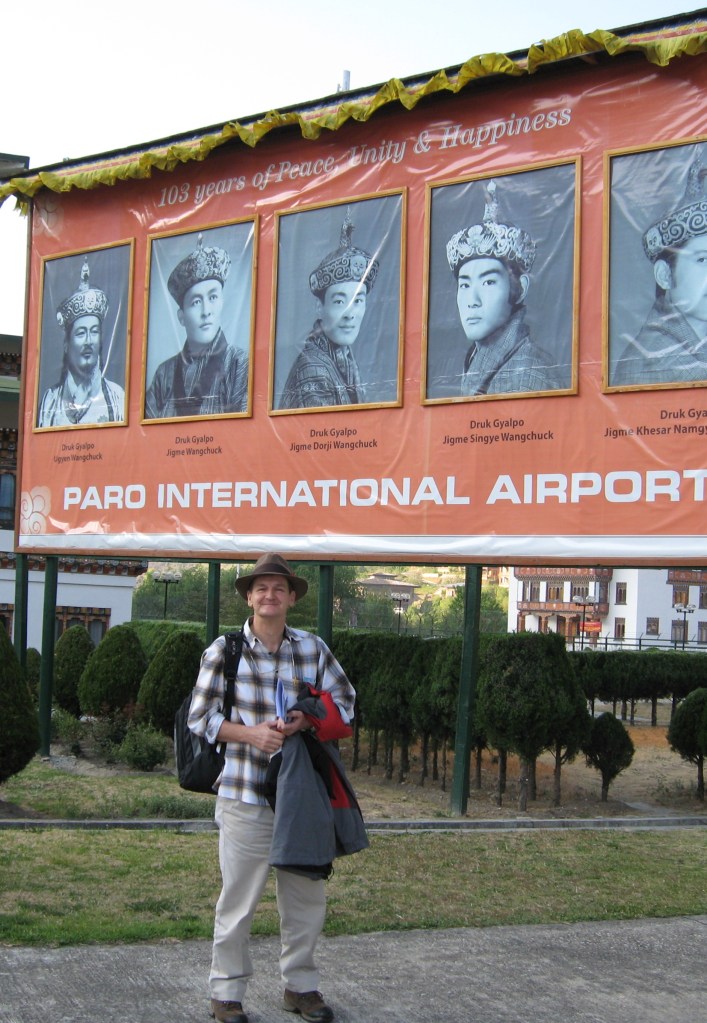
You get off the plane and walk to the rather quaint terminal building and, despite the altitude (Generally abut 2,200m) the first thing you notice is the air. I could feel the chunks of Hong Kong grit, that are pretty much permanently lodged up my nostrils, dropping away like so much clinker. The air was so good you could taste it. Half a dozen guys in dressing gowns cleared us through immigration and a young lady asked us if we had any cigarettes. Fortunately, none of us smoke. It seems that the penalty for bringing in excess ciggies is an immediate return flight. Bhutanese caught having a fag get 3 years in the pokey. I already loved this place.
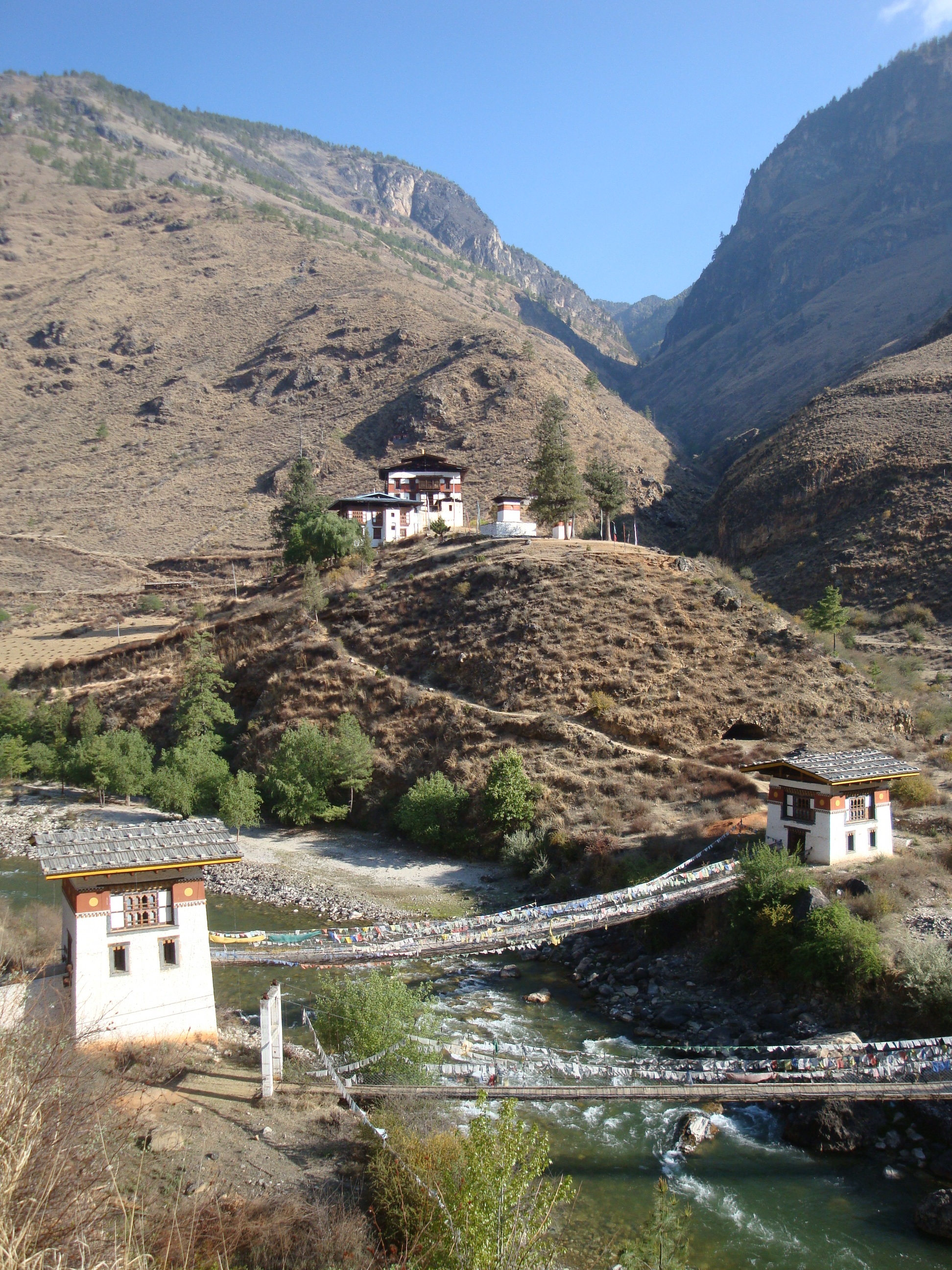
We were greeted by our Guide Tensing and our driver Namgay, they were both wearing dressing gowns. Nobody in this country seems to get dressed in the morning. They loaded us into our van and off we went. Half way up a narrow gorge, we stopped to look at a temple and a chain bridge over the river. We all climbed out of the van and Tensing and Namgay started to give their bums a good scratch, which struck me as a bit odd as we had only been in the van for 20 minutes.
Thimpu is the capital city of Bhutan, it is located in a broad valley and boasts Bhutan’s only highway. This is a dual carriageway that is about 200 yards long and boasts more crashes than the other 500 miles of dirt track. We pulled into our Hotel and, before they unloaded our bags, the boys had another good set to with their bums. There were various blokes standing about and chatting and I noticed that most of them were having a surreptitious scrit as well. I figured that Bhutan must have a toilet paper shortage. We checked into our Hotel, called the Phuntsho Pelri and after a cup of tea and a bicky, we set off to discover Bhutan.
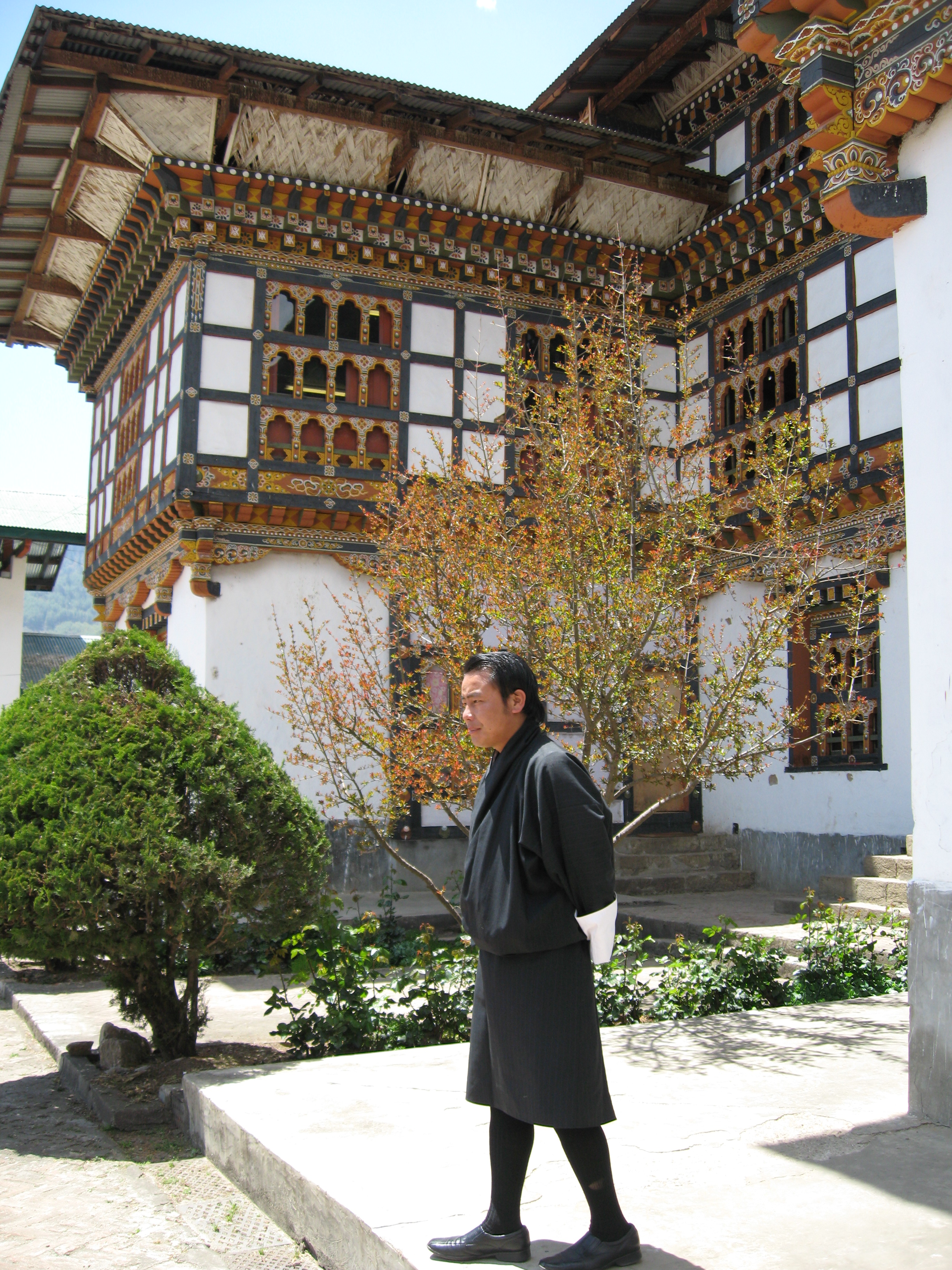
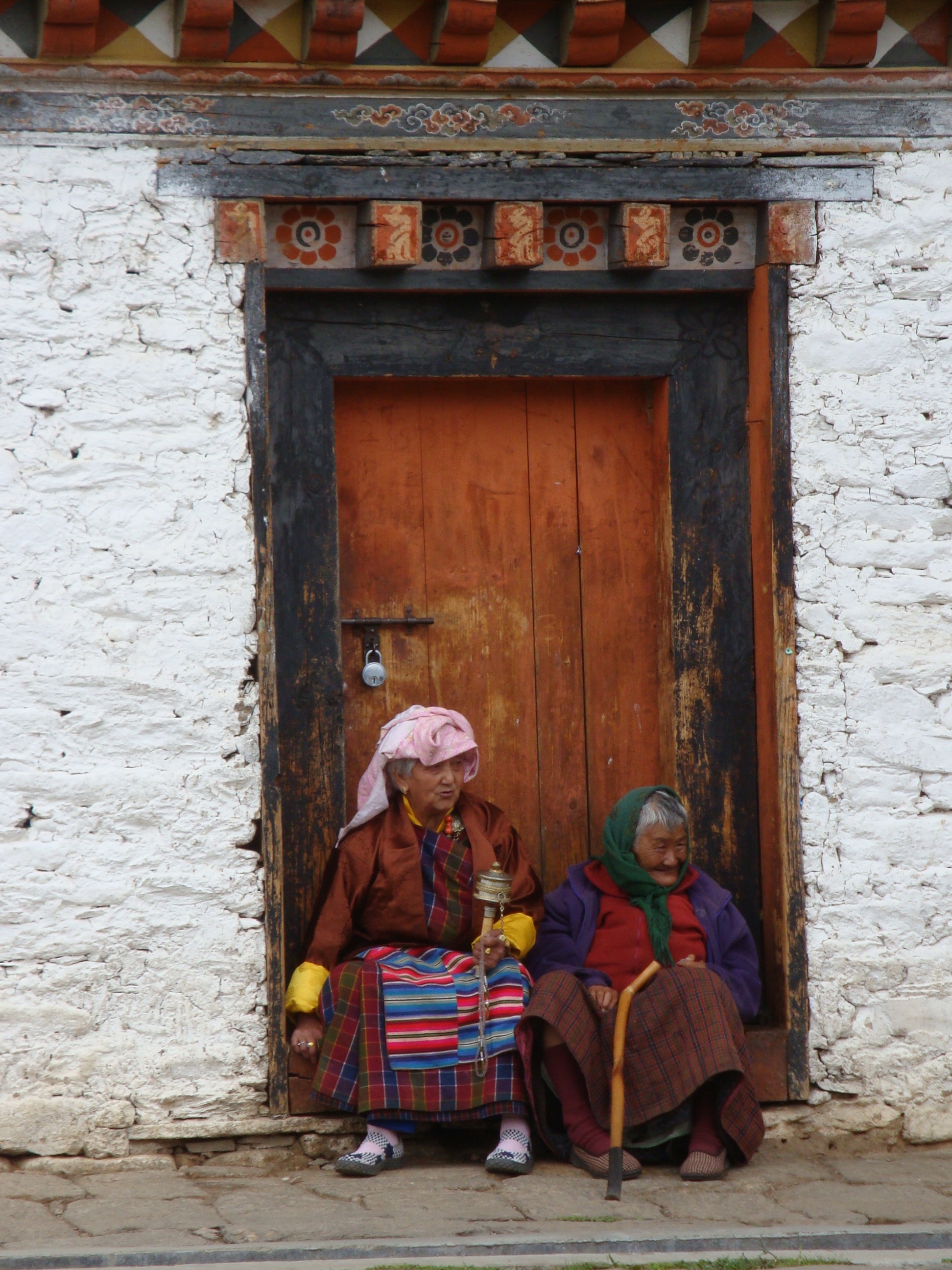
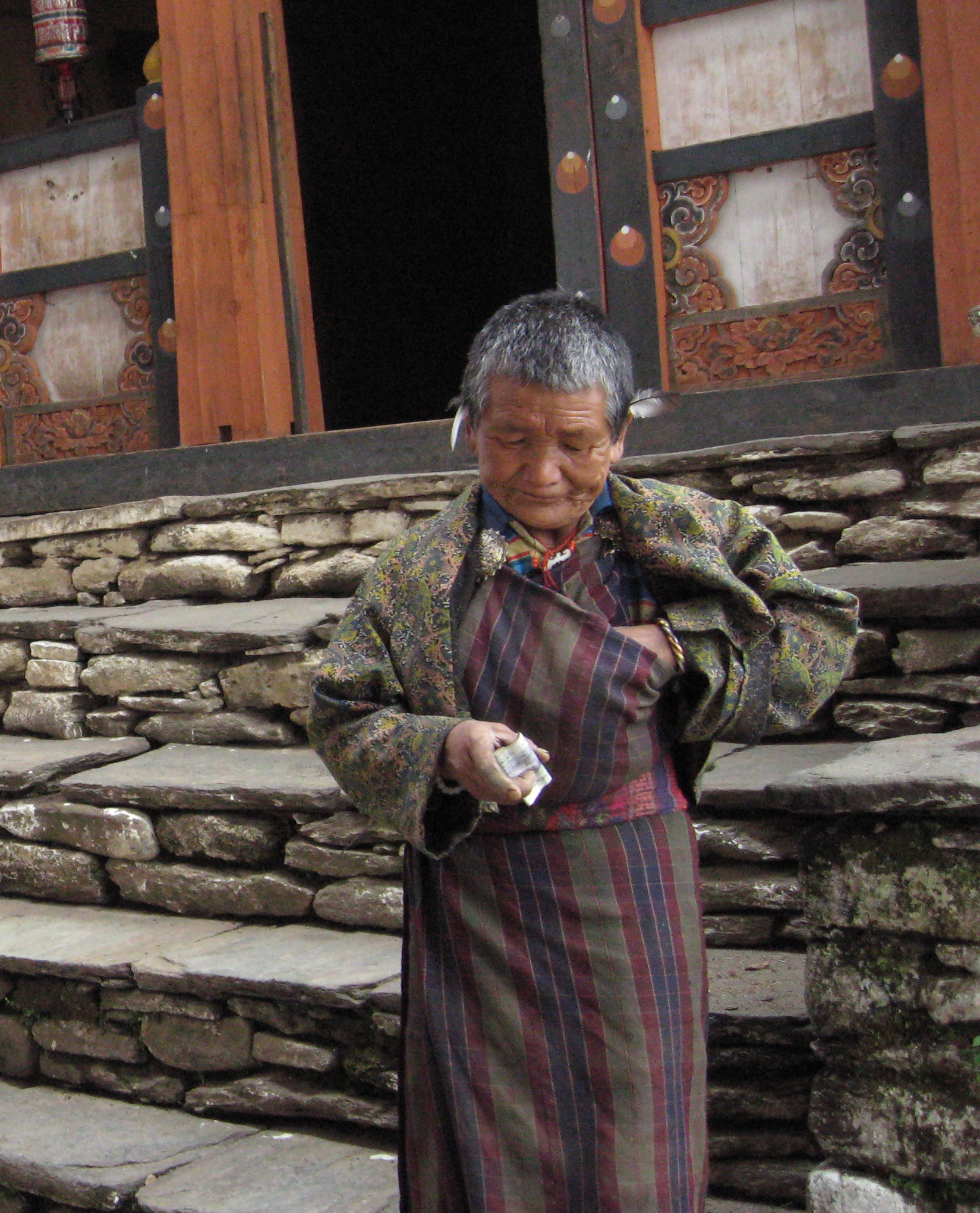
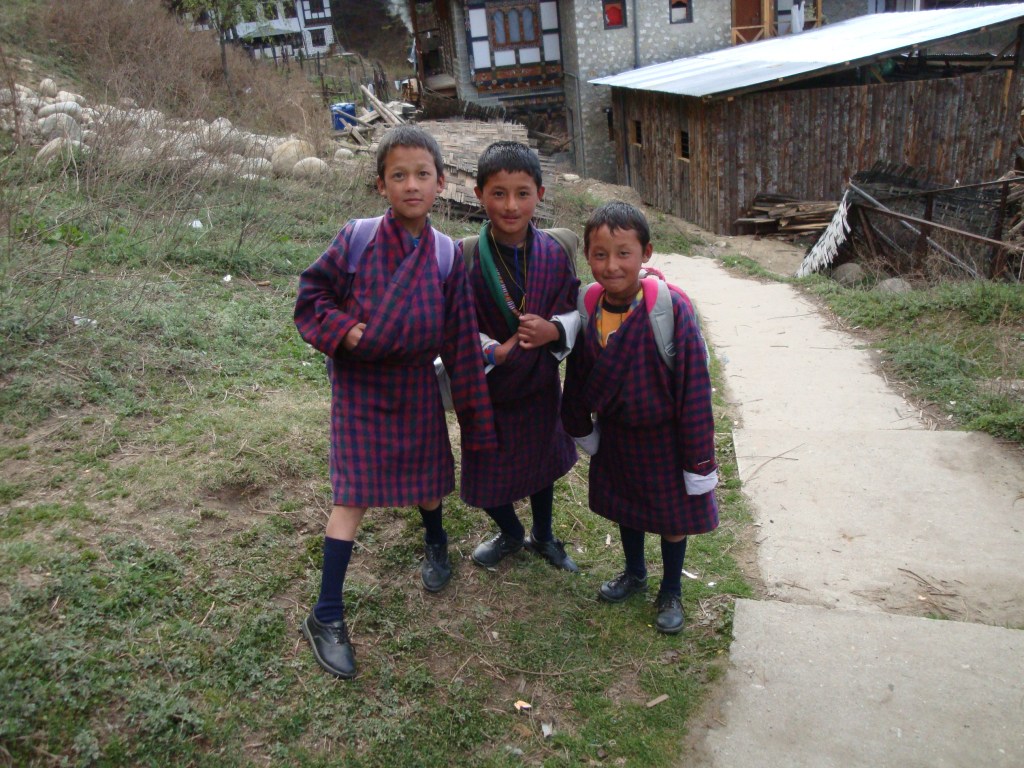
First stop, the National Textile Museum. This is about as exciting as it sounds, but it does explain why everybody is walking around in dressing gowns. The dressing gown is the National Costume of Bhutan. This place is really laid back. It is actually called a ‘Goh’, as in “Goh figure”. A sort of knee length Kimono for blokes, with huge white cuffs and a woven belt and it comes in pin stripe or tartan. Add to this a pair of knee high black socks and you are pimping, Bhutan style. Ladies wear a floor length tight wrap-around with a little bomber jacket, perfect for climbing mountainsides.

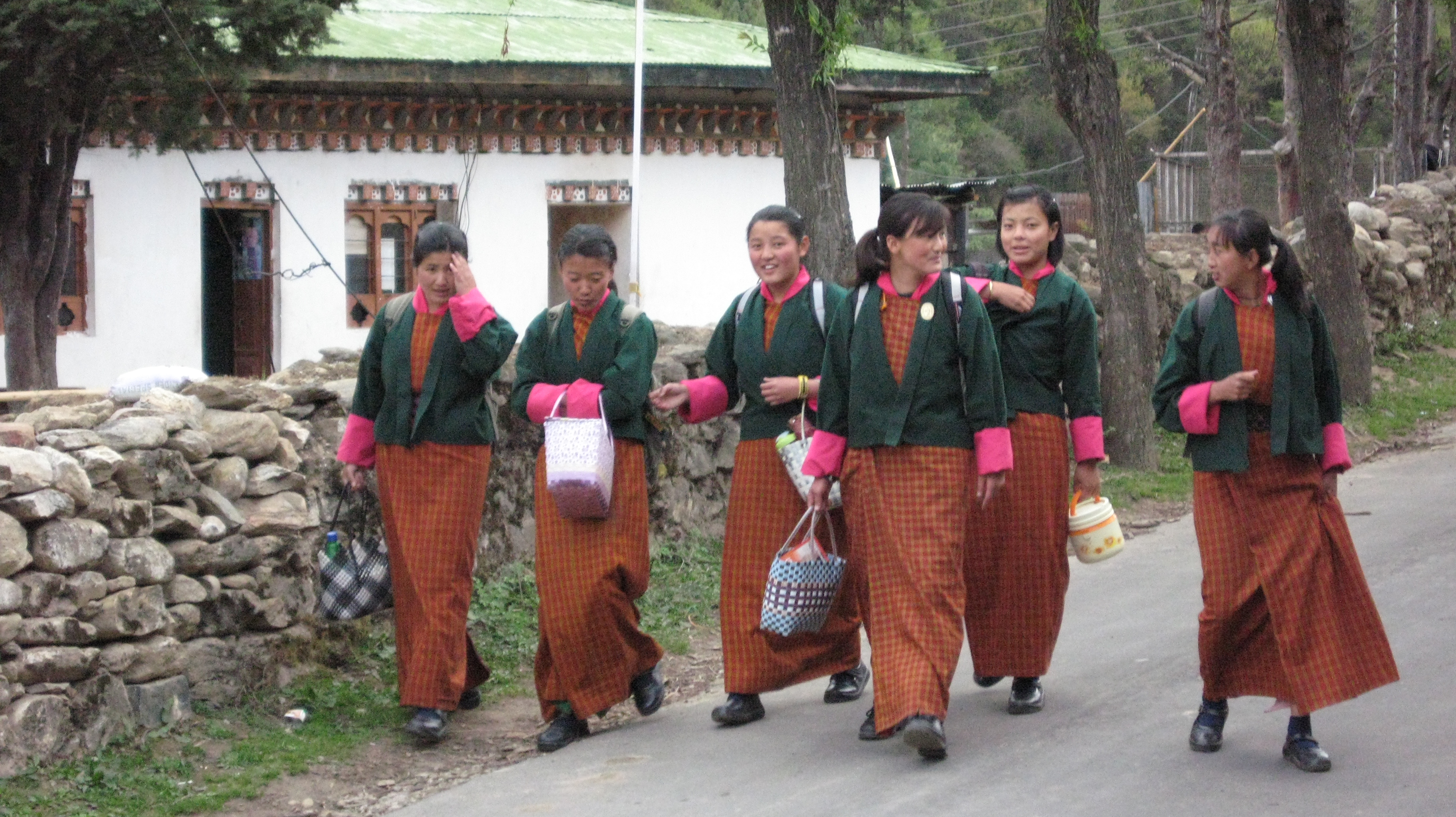
After that we went to the Art School. Room1, 18 guys and 2 girls drawing identical curlicues; Room 2, 20 guys carving identical wood masks; Room 3, 20 guys carving identical clay figures; Room 4, 1 guy and 5 girls copying the same embroidery; Room 5, 10 guys painting identical Buddhist Wheel of Life; Room 6, 8 girls weaving identical belts. All the guys wore the same tartan dressing gown and the girls, the blue cling-wrap. You get the idea. Art it ain’t, Craft it be. Beautiful, intricate, astonishing Craft, but how many Garuda Dance Masks do you need? We decided that we didn’t need any, although we did evidently need a wooden wall plaque depicting the never-ending Knot of Life.

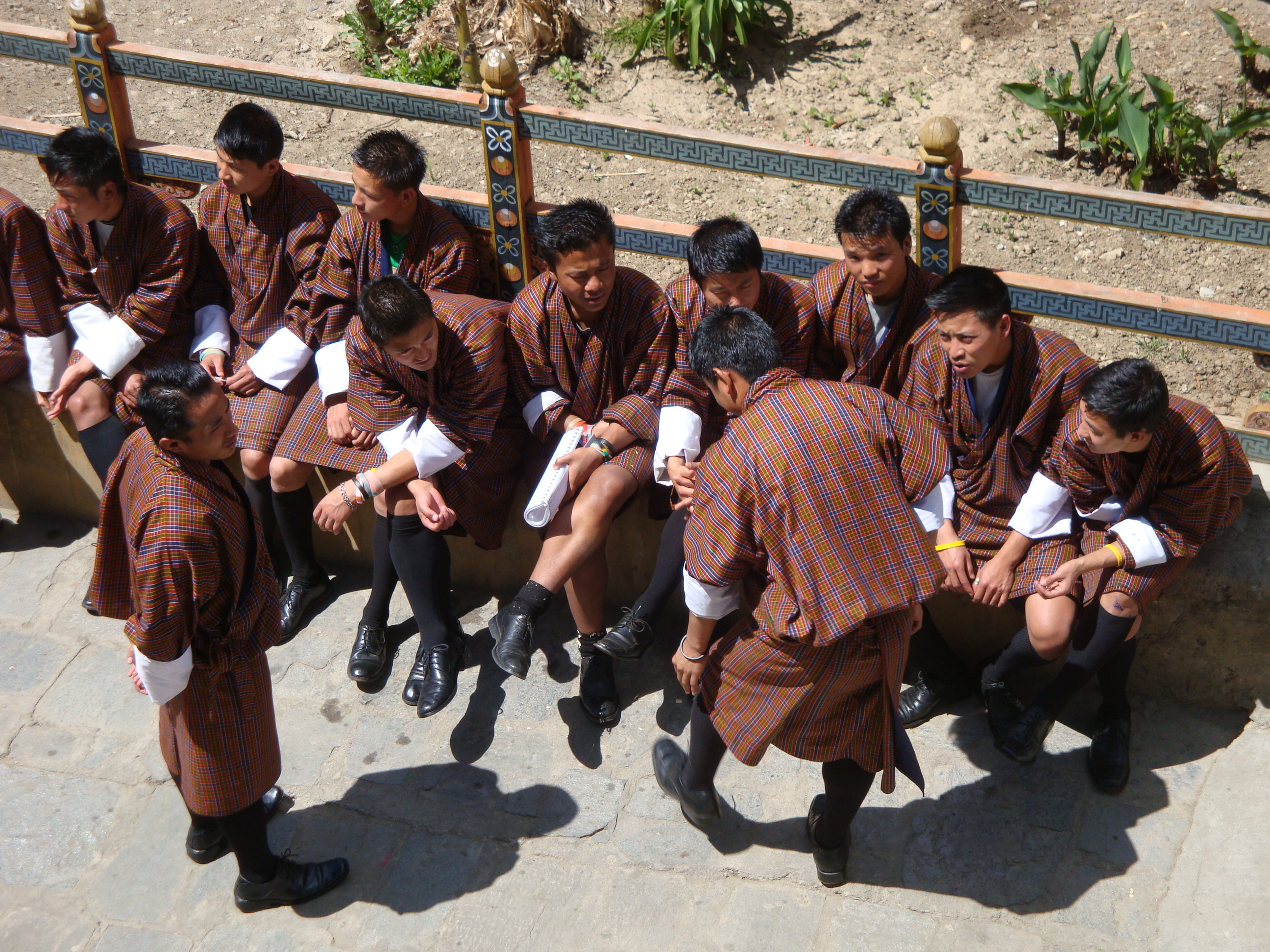
While we were there, the bell went for break and 75 guys all filed outside for a bit of R & R and a chafe at their back-bits. I had checked out the Hotel lavvy and registered an ample supply of bumwad, so that couldn’t be it. Then it registered. The Goh has two pleats down the back, below the belt and, once you have been sitting on them for a while they get all crinkled up and messy. So every Bhutanese gentleman who stands up, spends the next five minutes feeling round his nether regions to get his pleats straightened out. Very elegant. Goh figure.
We then went to see a Stupa, although it’s called a ‘Chorten’ here; our first Monastery, closed; and the National Zoo which contains about 3 deer and an animal called a Takin which appears to be a cross between a goat, a yak, a gnu and a moose. The Gods must have made this on one of their more whimsical days. Given their National environmental philosophy, the King decided to shut the Zoo and free the animals several years ago, but the Takin have got a good thing going with the free feed and don’t seem in any hurry to leave. Plus, they are so ugly that locking them up and keeping them bored is probably the only way to get them to mate. By this time, we were pretty pooped, especially having had one hours sleep on an airport chair, so it was back to Phuntsho Pelri, dinner and early to bed.
After a good night’s kip, we were refreshed and fortified with a good breakfast. Note; most eggs in Bhutan seem to have a white (not yellow) yolk. Goh figure. We set off to Tango Monastery, not far out of town, but half way up a mountain. The sun shone, but the air was cool and fresh, a sign at the entrance informed us that this was a “Holy place for the grooming of Rinpoches and would we please refrain from uproarious acts and fornication”.
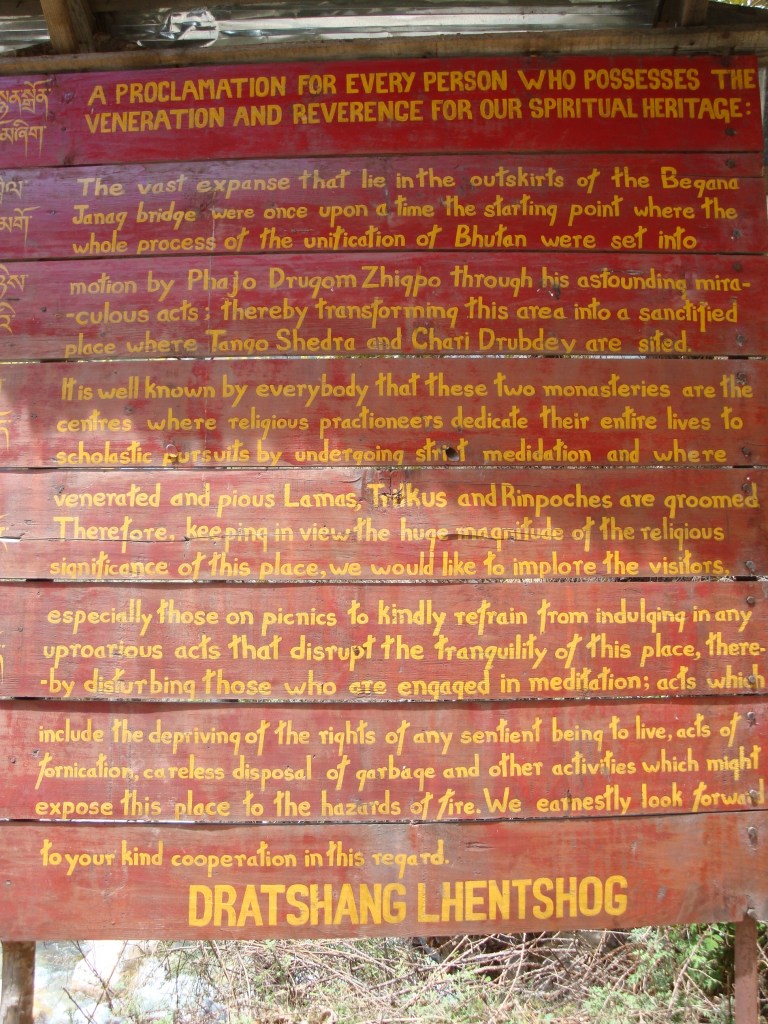
This was a major disappointment to me and I almost asked for my money back, but figured that they wouldn’t have security cameras yet, so determined to soldier on and see if I could get lucky. We climbed through beautiful forest of Pine and Cedar. Blood red, wild Rhododendrons in bloom. Eventually the canopy opened out and there were a couple of farm buildings, ponies grazing and then this huge white walled temple, a great over-arching roof and intricately carved wooden windows and eaves, leaning out over the valley. Spectacular. The colours so rich against the blue sky.
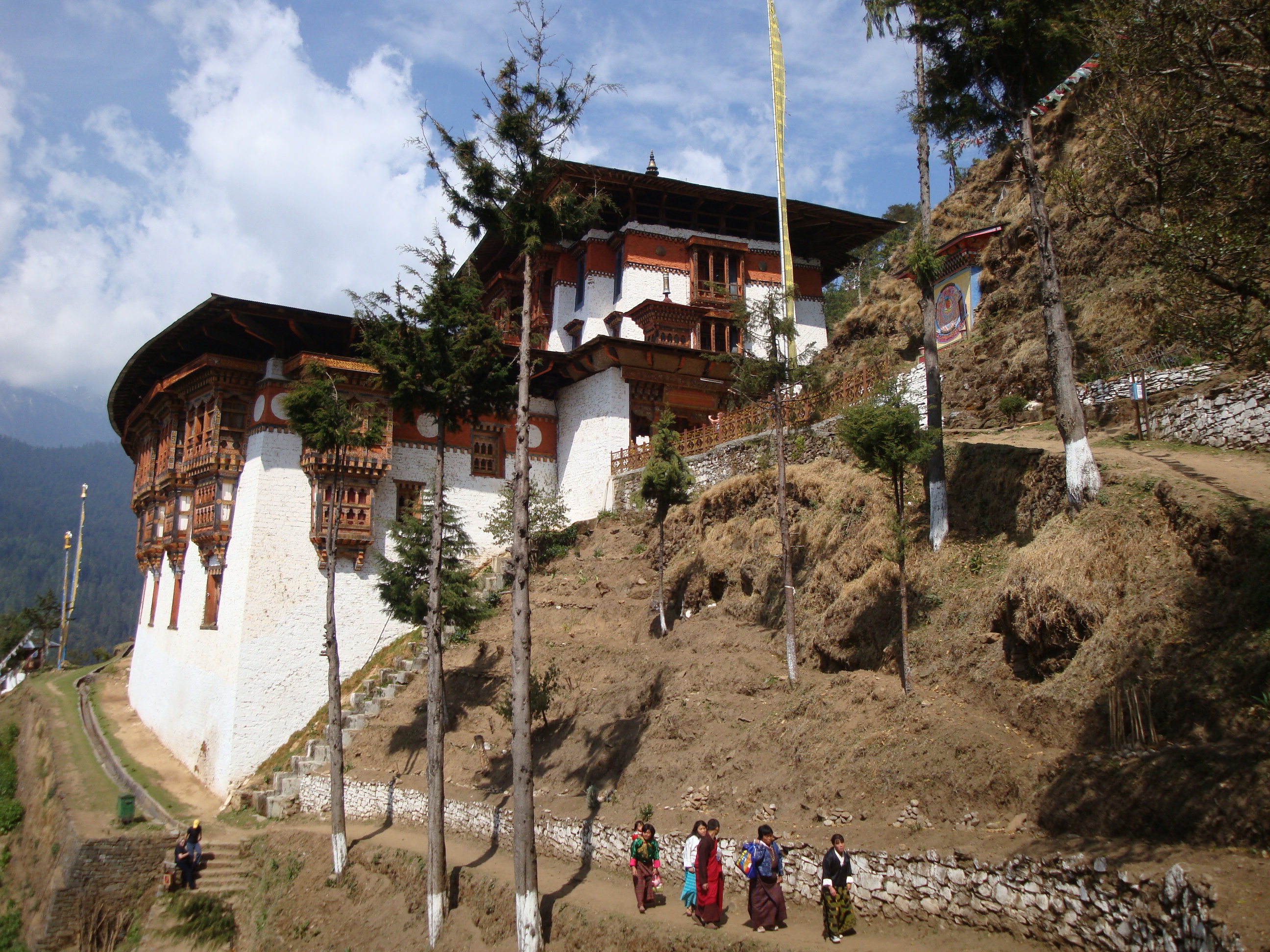
Locals in their finery were making the trek up the mountain, carrying ghee for the butter lamps. Monks peer out from windows. Beautiful. We got the same stories as in Tibet; Past Buddha, Present Buddha, Future Buddha, Reincarnated Buddha. He’s a busy old Buddha. I would like to imagine that I am getting some sort of enlightenment, but it’s not happening. I try, but all the magic and voodoo gets in the way.
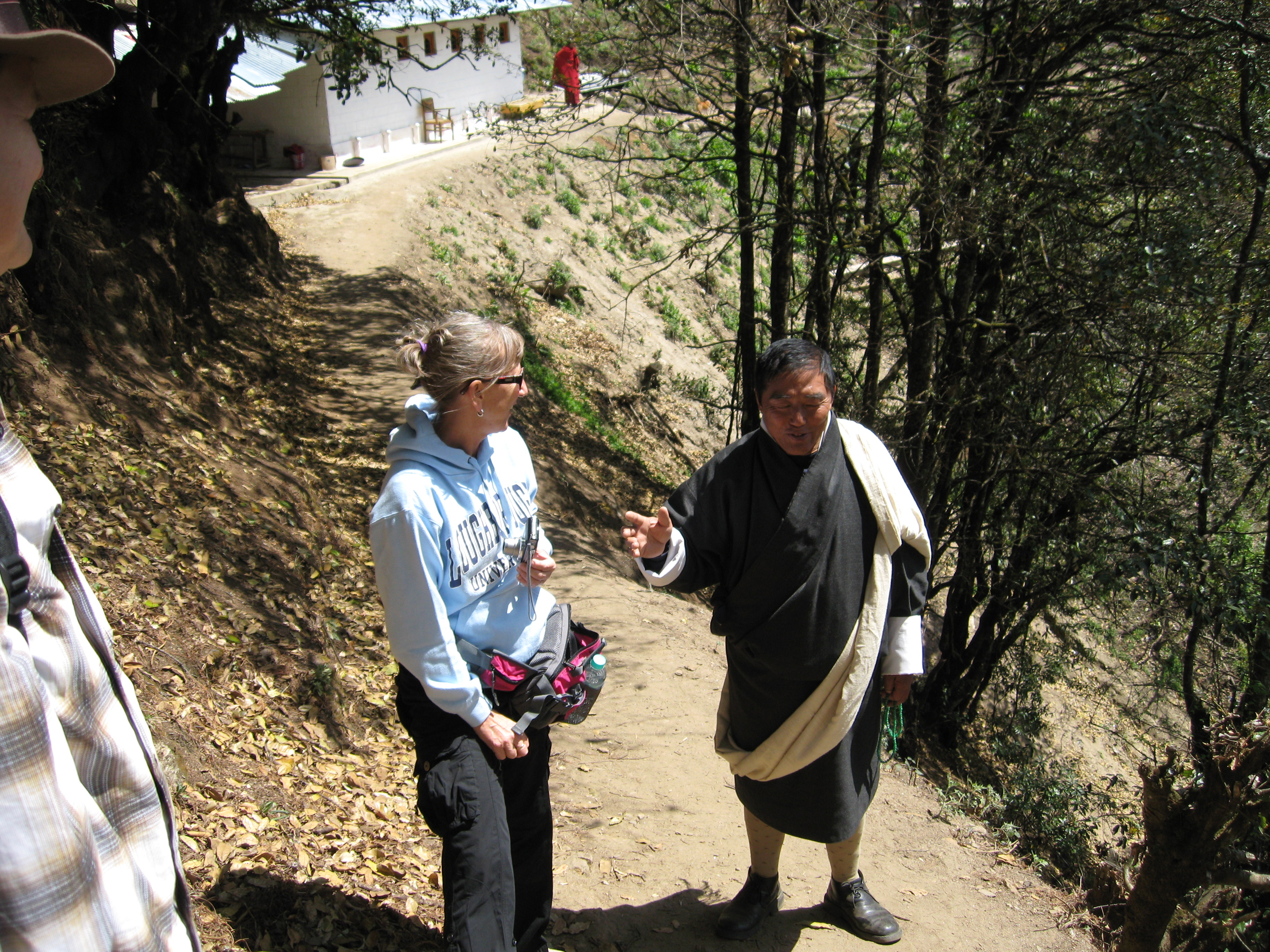
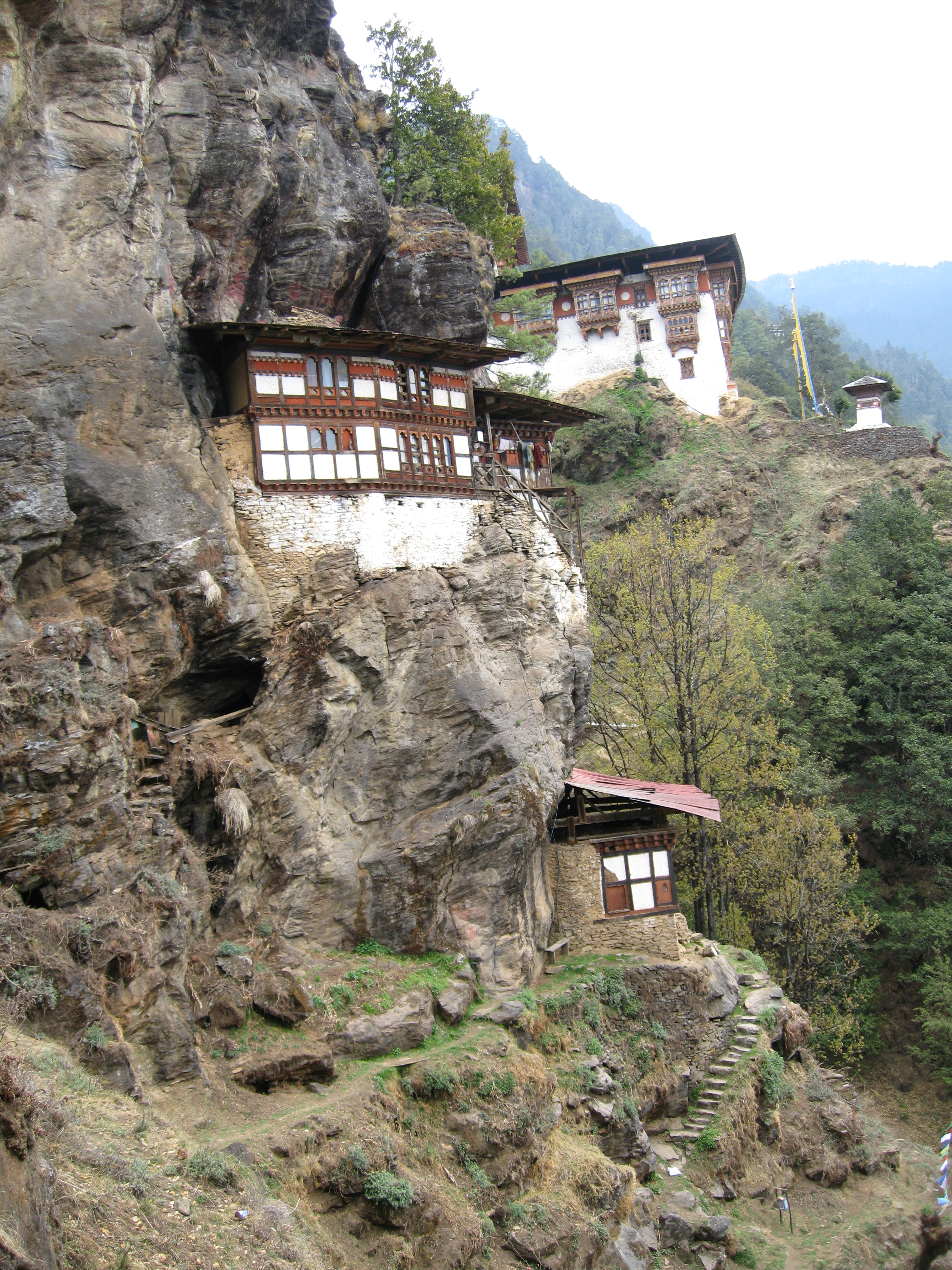
But the beauty of it all makes you believe in something. That Nature is stunning, that People are amazing, that there is Good in the World and that Life is a wonderful happenstance. We climb down the other side of the mountain and see smaller temples glued to the rockface. A passing Bhutanese Gentleman gives us a spontaneous lecture on the power of belief. I believe, but my belief is different to his. Not better, just different. And by this time I believed that I was hungry and I knew that I was right in that.
Meals in Bhutan consist of vegetables, rice and a little bit of meat. The veggies are all locally grown and delicious, but because Bhutan is almost totally Buddhist, there are no slaughterhouses. They all eat it, they just won’t kill it. This is just one of many dichotomies in Bhutan. So, all the meat has to come up from India, having been killed there by non-Buddhists who are all going to Hell, thank you for helping to keep Bhutan pure.
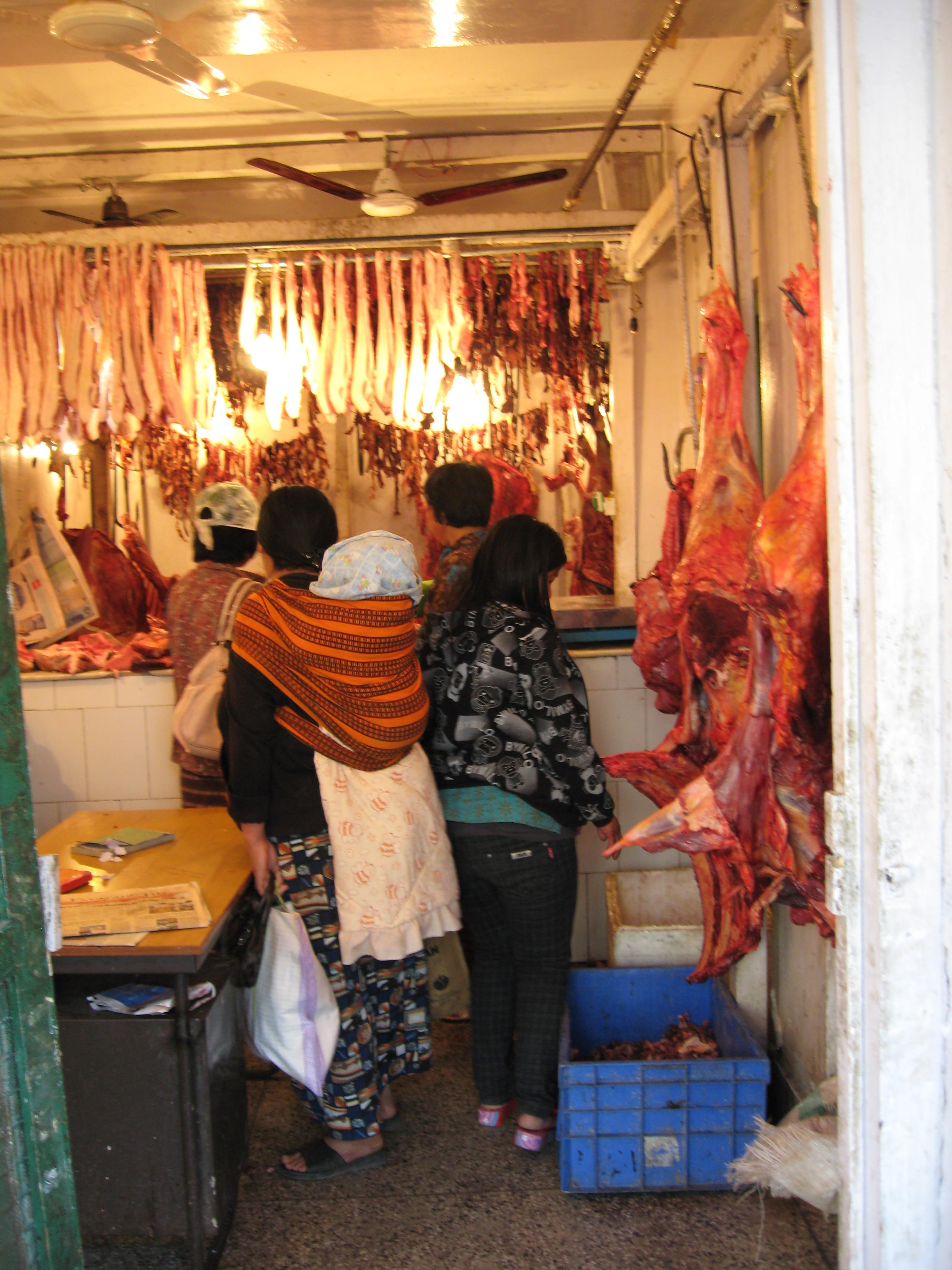
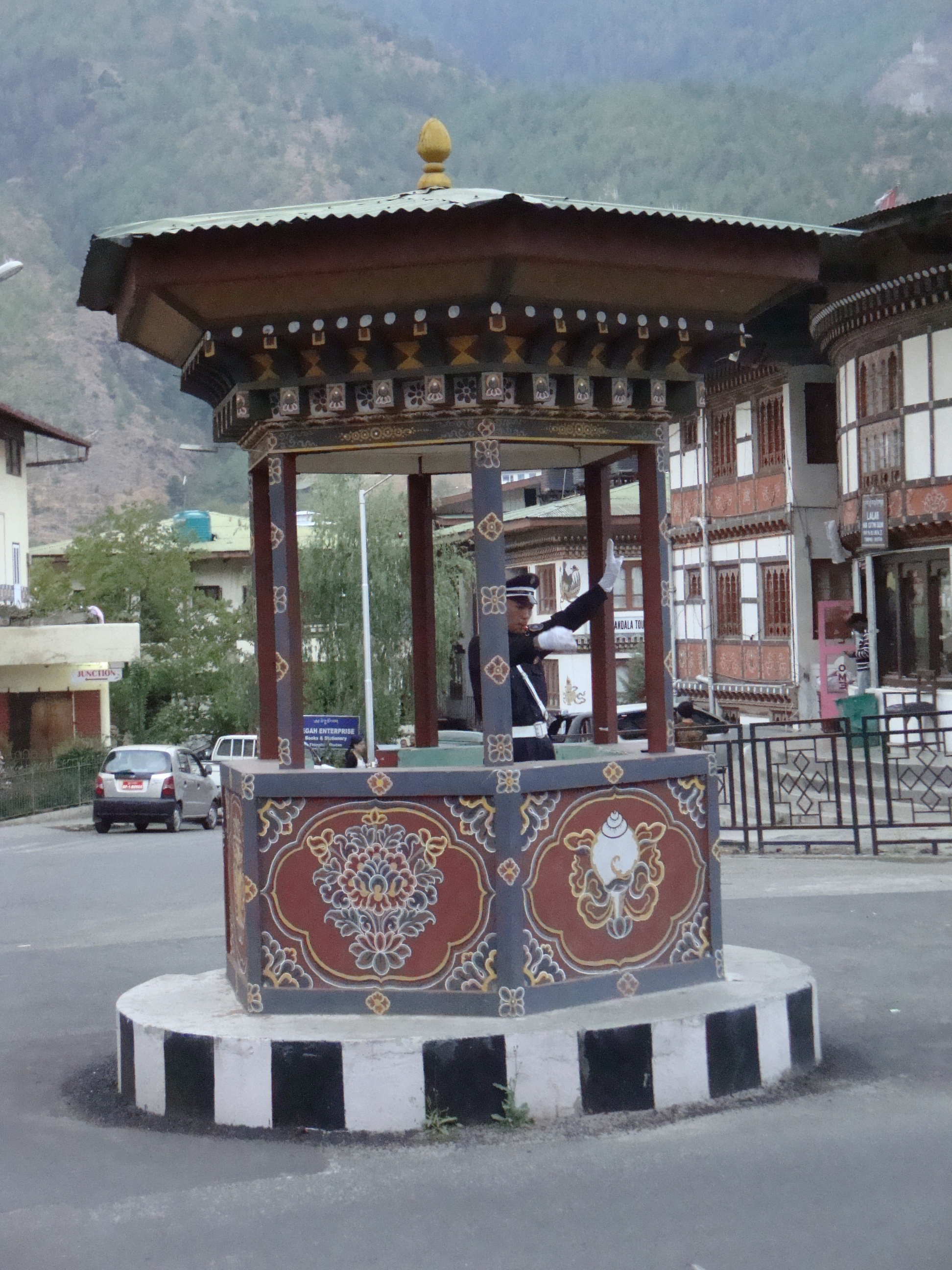
Given that the Hindus don’t eat cow and the Muslims don’t eat Pig, this can make things a bit tricky. Pork is inevitably 95% fat and Beef is quite often 95% cartilage, so Chicken is a treat. It’s all very tasty, with loads of beans, carrots, squash, aubergines, peas, potatoes and ferns. Yes, ferns. In Spring they pick edible fern shoots and sauté them in a cheese sauce. Delicious. Strangely, you hardly get any curry, but every meal is accompanied by a big bowl of green chillies in cream, which are fabulous but, as I found to my cost, capable of stripping out your stomach lining.
Also, the effect of so much veggie roughage on my rather hyperactive digestive system, resulted in a prodigious production of methane. At first, I really tried to be discreet about this, but after a couple of days gave up all pretence. The Monk’s mountain horns came in a quiet second to my continuous trumpeting.
After lunch we tootalled about and were taken for a cultural show, where we met Tashi himself, a really nice bloke who cracked a bottle of wine while we sat on a stage and watched singers and dancers, leaping about on a concrete floor covered in sharp stones.


Something about this struck me as odd. But the wine was nice and I was comfortable. Afterwards, they dropped us off at the Farmers weekend market and we looked at veggies and bought knick-knacks, although you can bet that, apart from the wood carvings and weavings, most of this stuff is made in Nepal.
Day 3 and we had to put on pants to visit Thimpu Dzhong, which is this huge fortified monastery, but also acts as the local Government headquarters. Next to it, is the new National Government Assembly and the King’s Palace. Buckingham this ain’t. Bless him, the King lives in a house not much bigger than a council bungalow, except it’s got a gold roof. The current King is a young batchelor dude, but it must have been a bit cramped for his dad, because when he was King he married 3 sisters all at the same time. There must have been a shed round the back where he could go for a break, but it’s against the Law to stop and look and it’s 3 years in the pokey for taking a photo anywhere in the general direction.
Outside in the Government car park is a space reserved for the Secretary of GNH. Bhutan does not measure its success in terms of Gross National Product, but rather in terms of Gross National Happiness. This does not mean that someone has to sit around telling really disgusting jokes while Government Officers check to see if everybody is laughing. Rather than measuring how much money the average family has, they try to evaluate how happy the average family is even though they don’t have much money. Of course, it helps if you’re Buddhist, because there is nothing much you can do about Life, so you might as well be happy and hope you get a better shot next time round.
The Dzhong itself is massive and the Architecture incredible, all stone and wood and not a nail or a screw used (So they tell you).
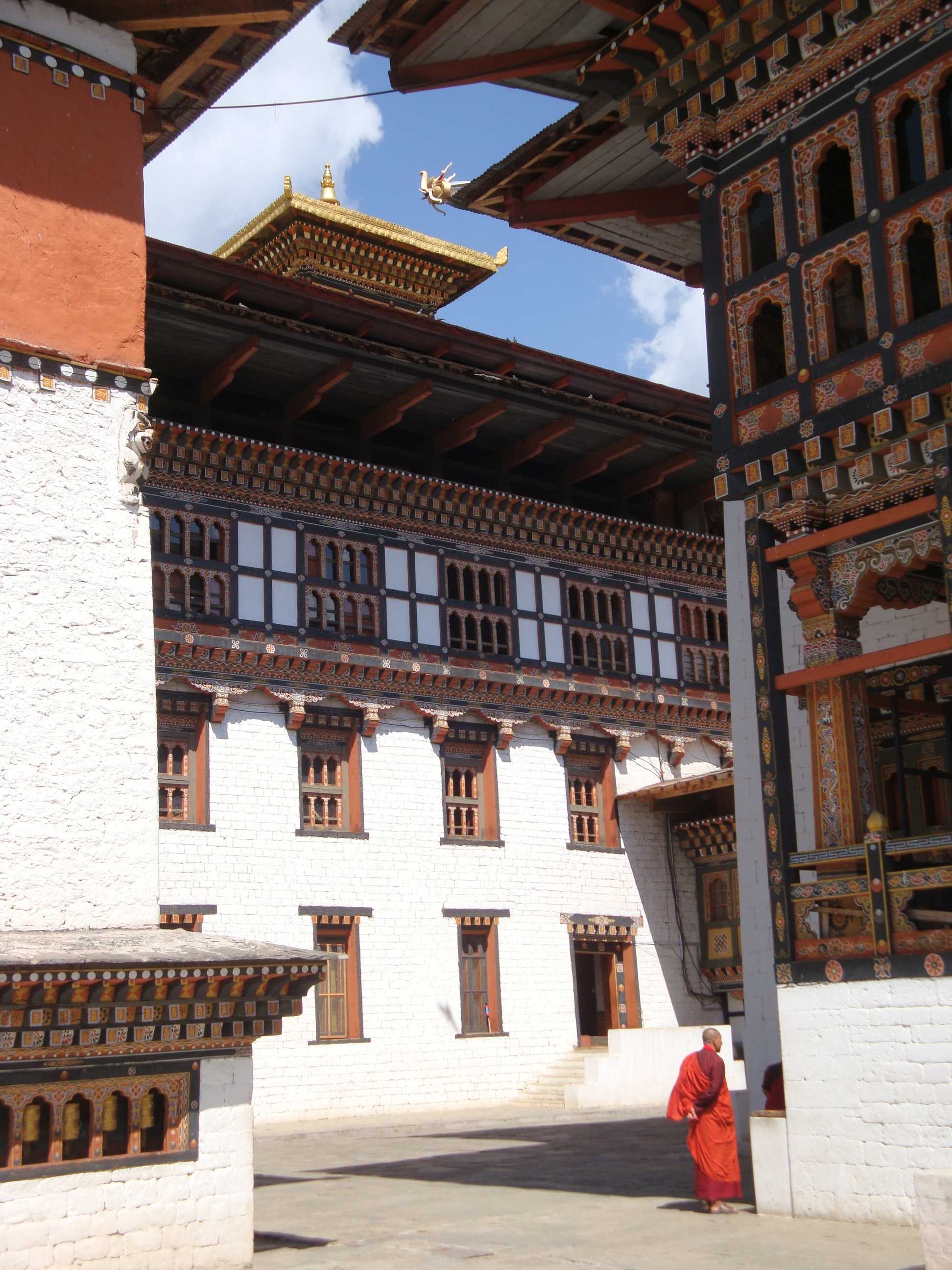

However, in the good old days, all these massive roofs were covered in Cedar shingles, held down with rocks and string, but these had to be replaced on a fairly continuous basis until someone discovered corrugated iron. Funnily enough, it looks quite in keeping and my bet is that the Chief Abbot has the franchise.
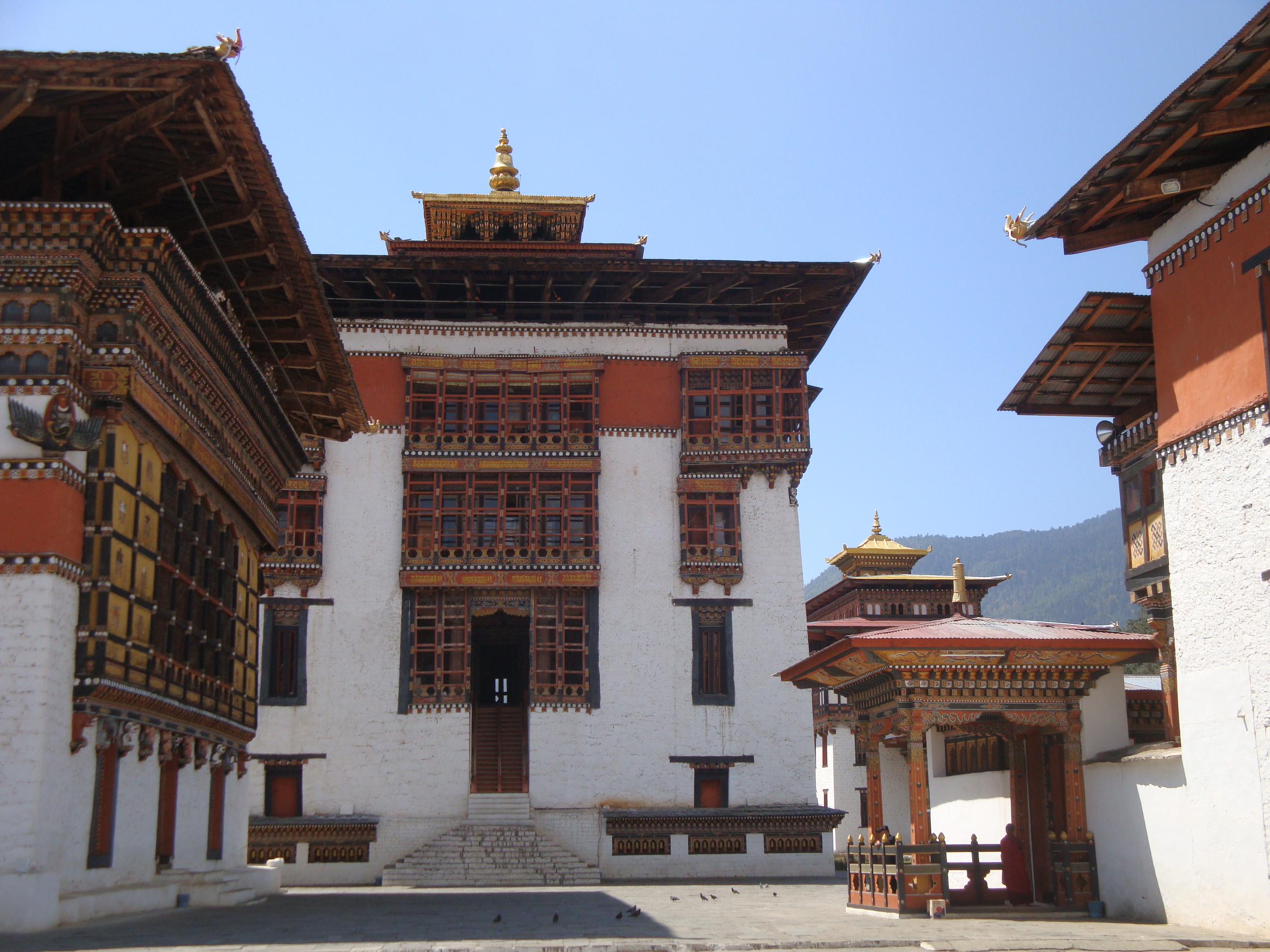
But the woodwork, the fretwork, the carvings and the paintings are truly superb. The Bhutanese pride themselves on the fact that their Architects do not have drawings, they just make it up as they go along. Somehow this seems to work and any mistakes become ‘Features’. Although, this latest Dzhong appears to be very similar to the first one, maybe, like their ‘Art’, a good thing tends to be a repetitive thing.
From here we drove to Metshina. This involved our first serious cross mountain range drive. After leaving the Thimpu highway we took the only other road in Bhutan, the cross Nation, East-West, A1-M1, Super-Express, Pony Trail. A single track, slightly macadamized, hairpin structured, pot-holed, bobsleigh luge, that carries all the traffic there is. Tourist cars, vans & buses and Local cars, buses, tractors, enormous great multi-coloured trucks and cows. A surprisingly large amount of all of the above and, oh yeah, ‘Woman Tours’, a gaggle of older, North American girls with short grey hair and sensible shoes in matching dayglo jackets and helmets with rear view mirrors, straddled atop some serious mountain bikes. After a truck delivered their bikes to the mountain pass, these ladies were attempting to compete for roadspace on the downhill section. There was a lot of cushioning being put to good use, as were the mirrors, but a few ‘Wide Load’ signs would have come in handy. Game girls though, although I doubt that was the phrase being used by the truck drivers trying to negotiate this additional hazard. “Dykes on Bikes” was the phrase that sprang to my lips before I had time to think better of it and avoid the inevitable punch in the ear.
The mountain pass itself was spectacular, wide views of the Himalayas, Red and Pink Rhododendrons, Pink dwarf Azaleas, Snow White Magnolias, Golden Yellow Gorse & Euphorbia, clouds of Amethyst Primula, creamy wild Strawberry and huge great Cedars festooned with Silver-grey hanging mosses. The Bhutanese are big into prayer flags. The Pass looked like wash day at Walton Pit.
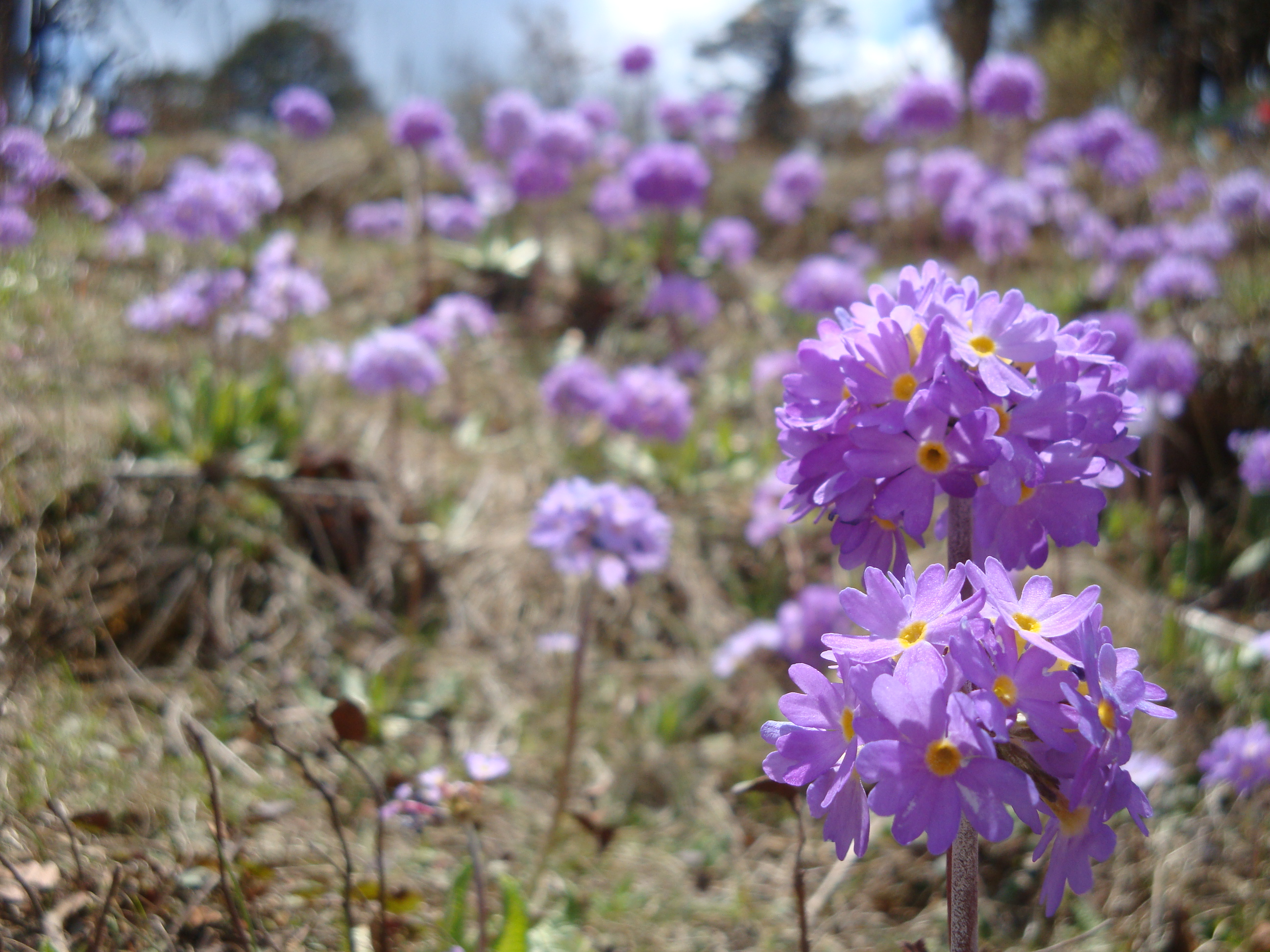

You could not walk between the trees without tripping over yet another line of towels. Pretty though they are, when first put up, they fade to grey in the elements and methinks that when the prayers are spent, someone ought to be employed to take down the bedraggled remnants. A troupe of black and white goats were having a go but there were just too many wildflower temptations for them to get seriously into it.
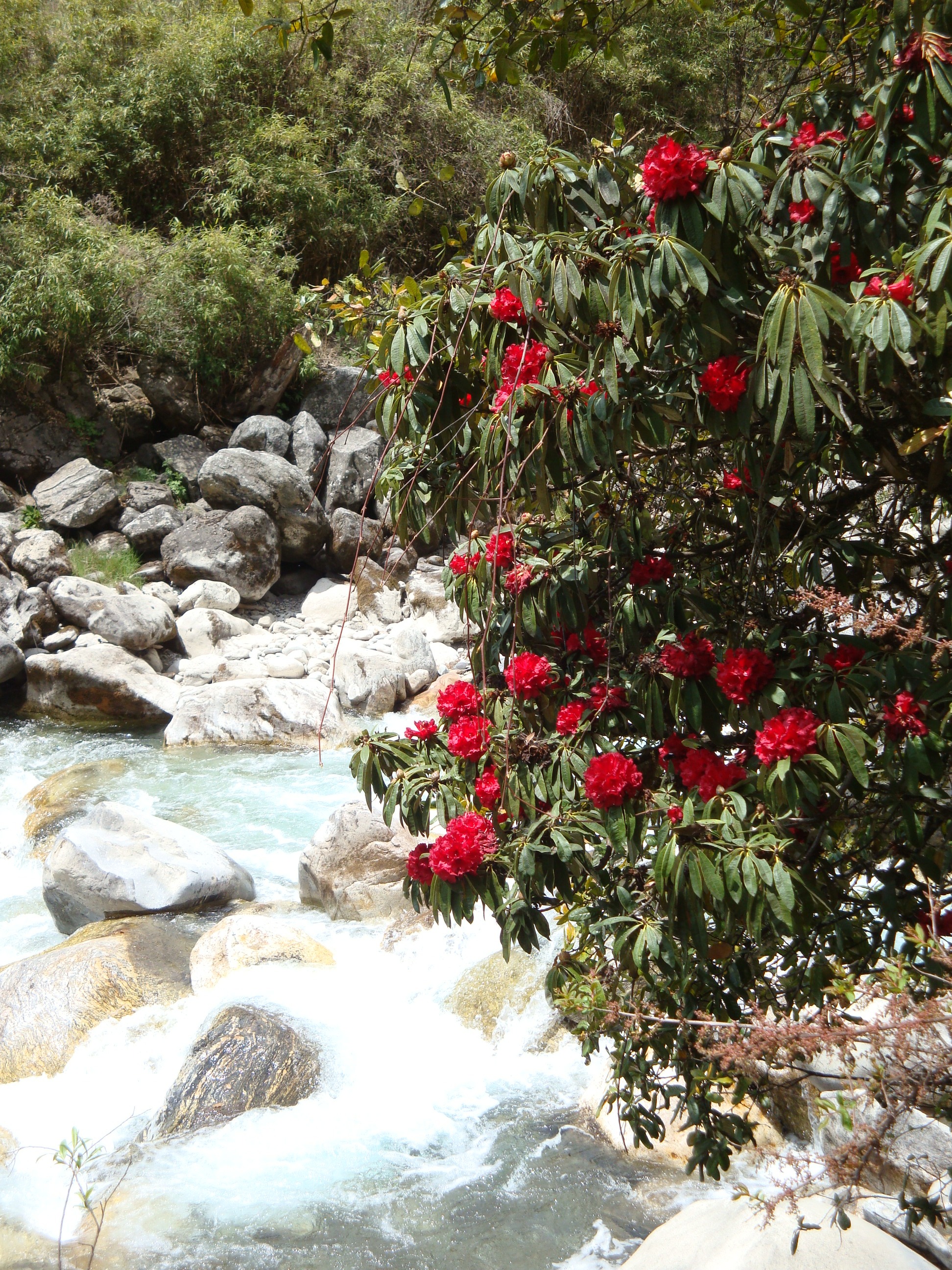

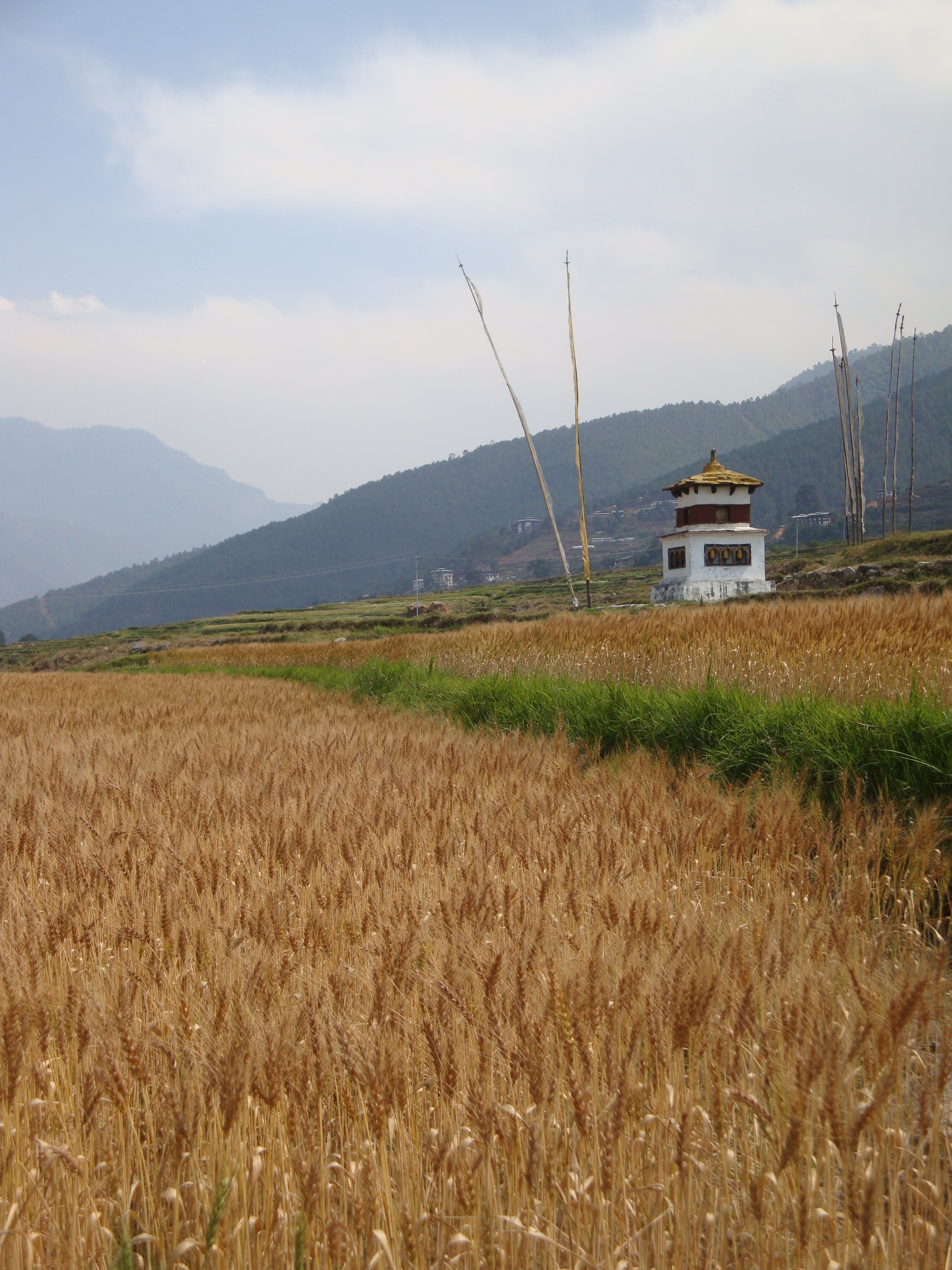
Dropping from the pass, we left the high-altitude, cloud fed fauna as it blended into rich multi-coloured forest, all the new leaf breaking out in wild greens and coppers, little waterfalls amongst moss covered rocks at every turn and then suddenly dropped into semi-desert. Quite a shock, the valley floor parched grey and red, patchworked with fields of golden winter wheat, the greens waiting for the Summer floods, but even here, clusters of prickly pear with bright sunshiny flowers.
We stopped for lunch and then walked through the fields to Chimi Lhakang, the Temple of the Divine Madman.
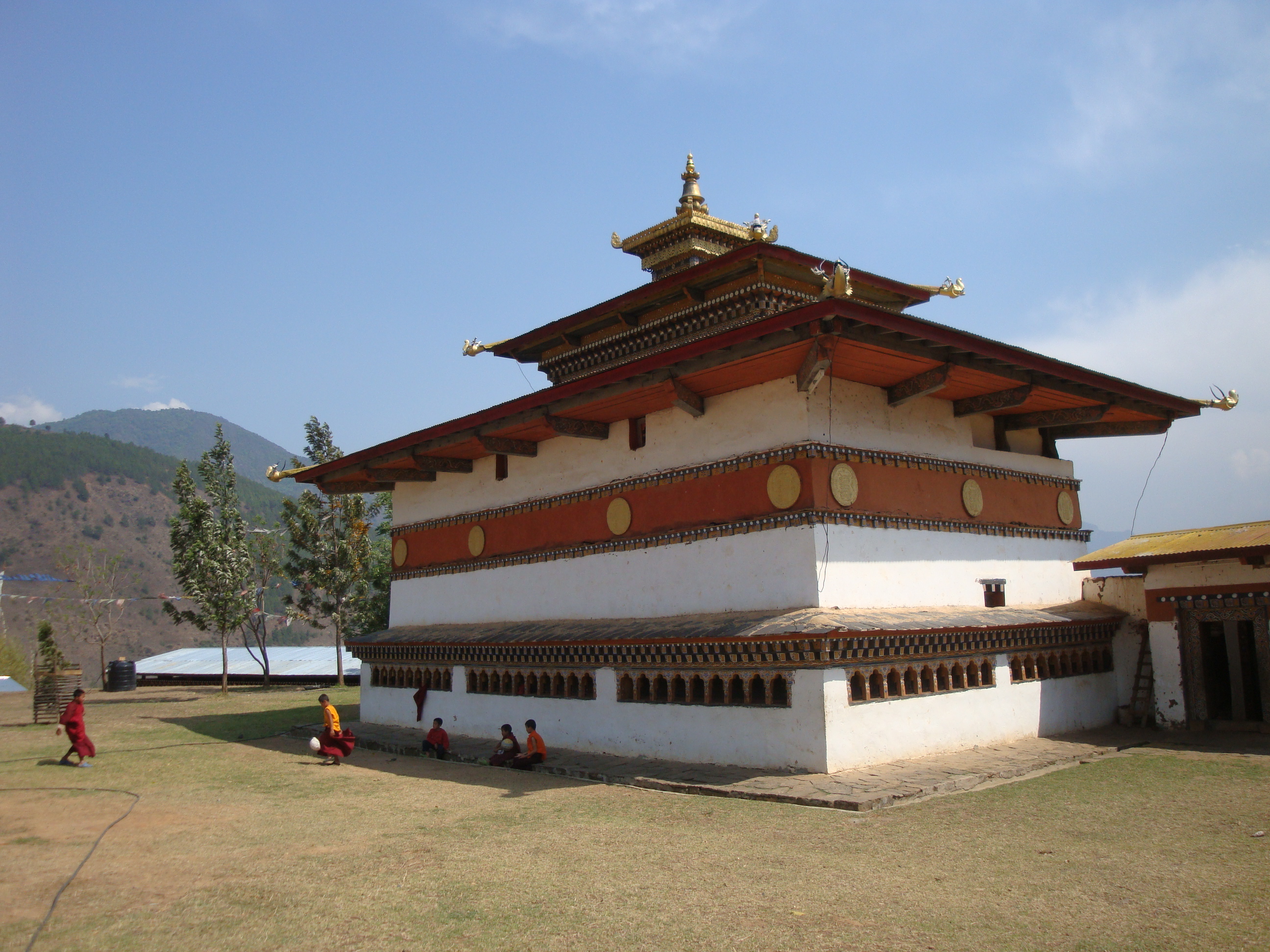
To give him his proper name, Lama Drukpa Kunley was bit of a lad. Coming to Bhutan at the end of the 1400’s he preached Buddhism by getting hammered, telling obscene jokes and bonking any woman he could get his hands on. He is revered as a folk hero and, I am sure, if Buddhism was still taught in this manner, conversion of the entire World would only be a matter of course. His legacy is so potent that many houses in Bhutan have enormous great willies painted outside the front door and wooden dicks hanging from the corner eaves, in order to protect them from evil spirits. Goh figure.
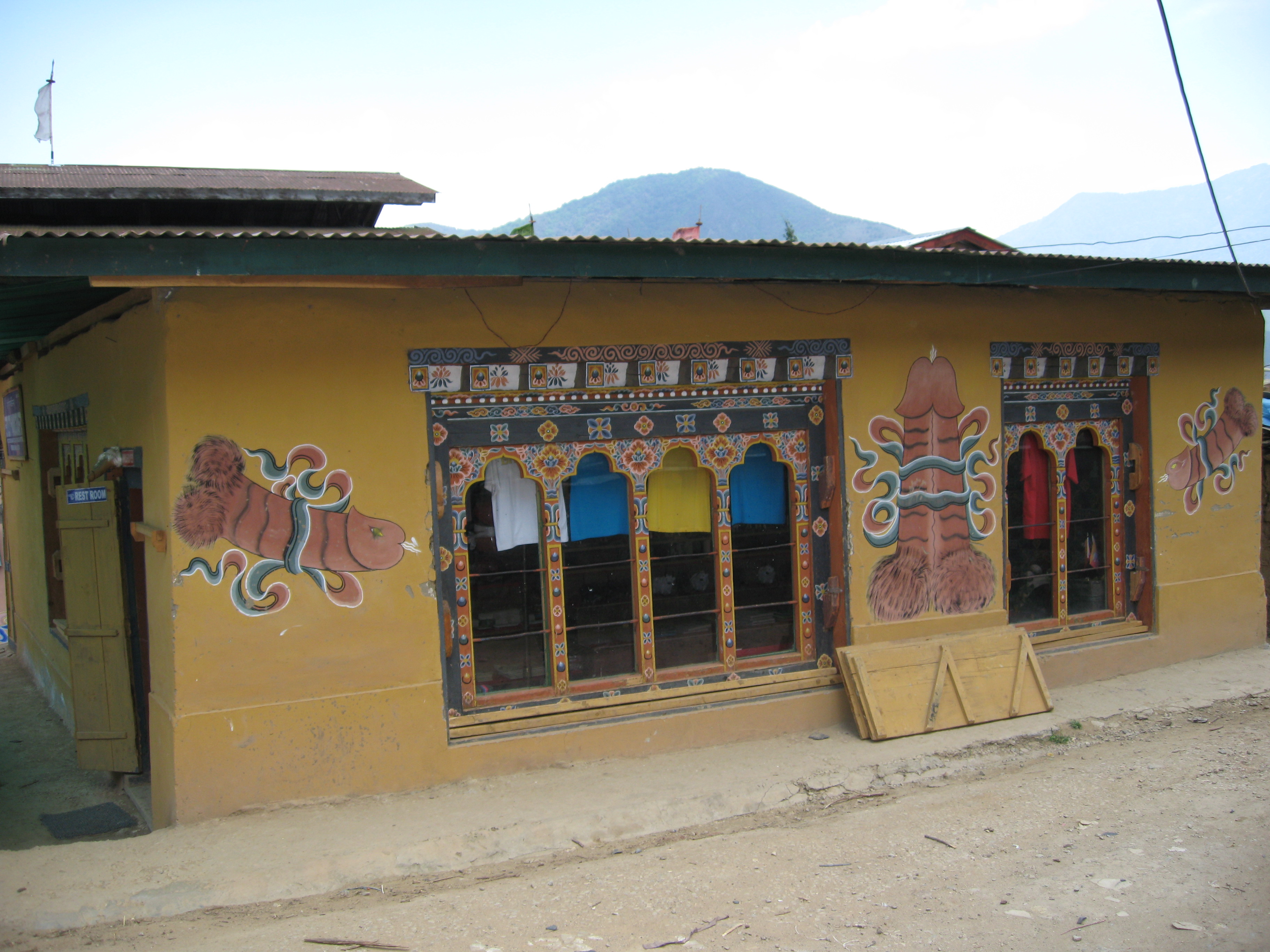
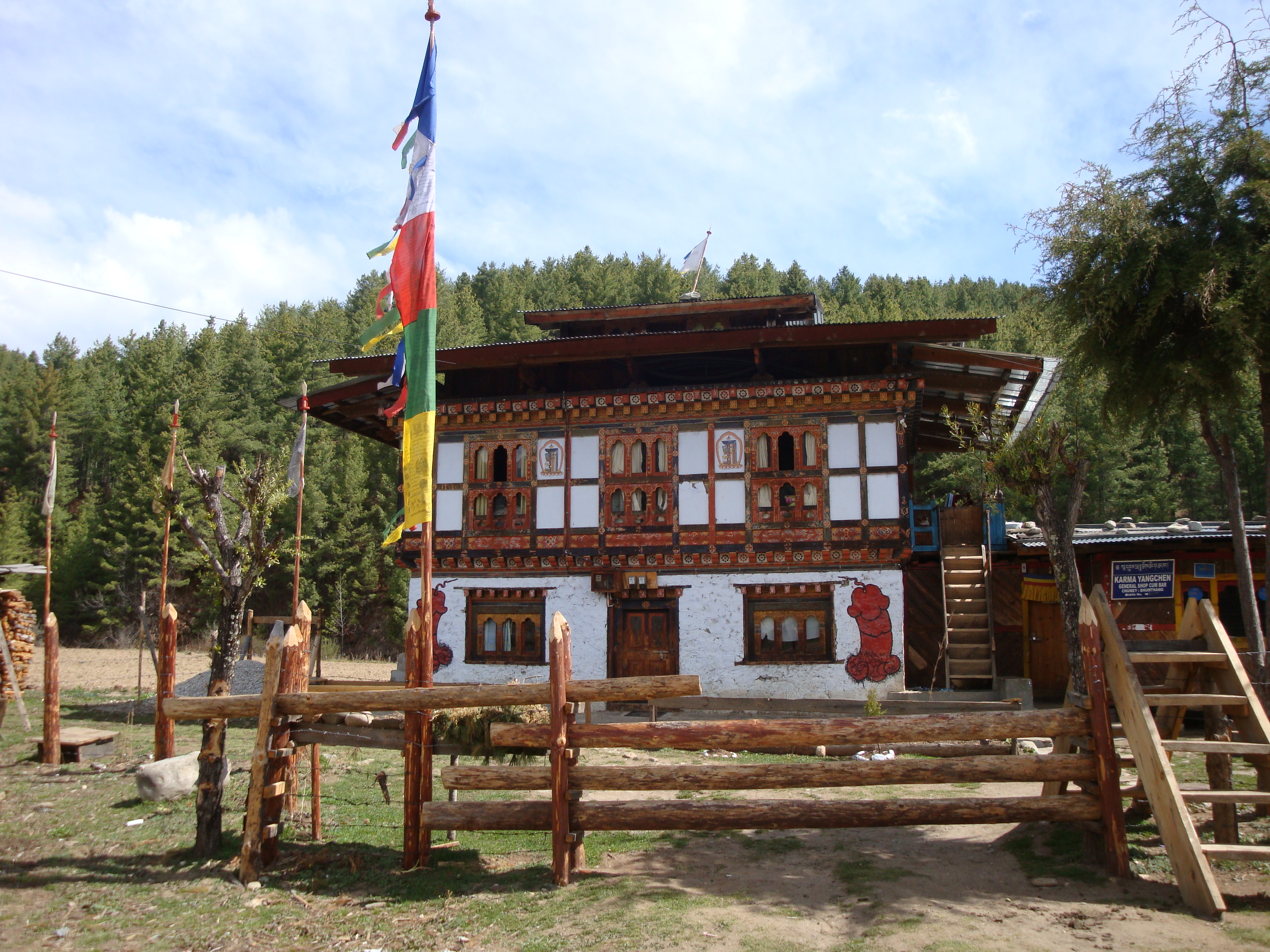
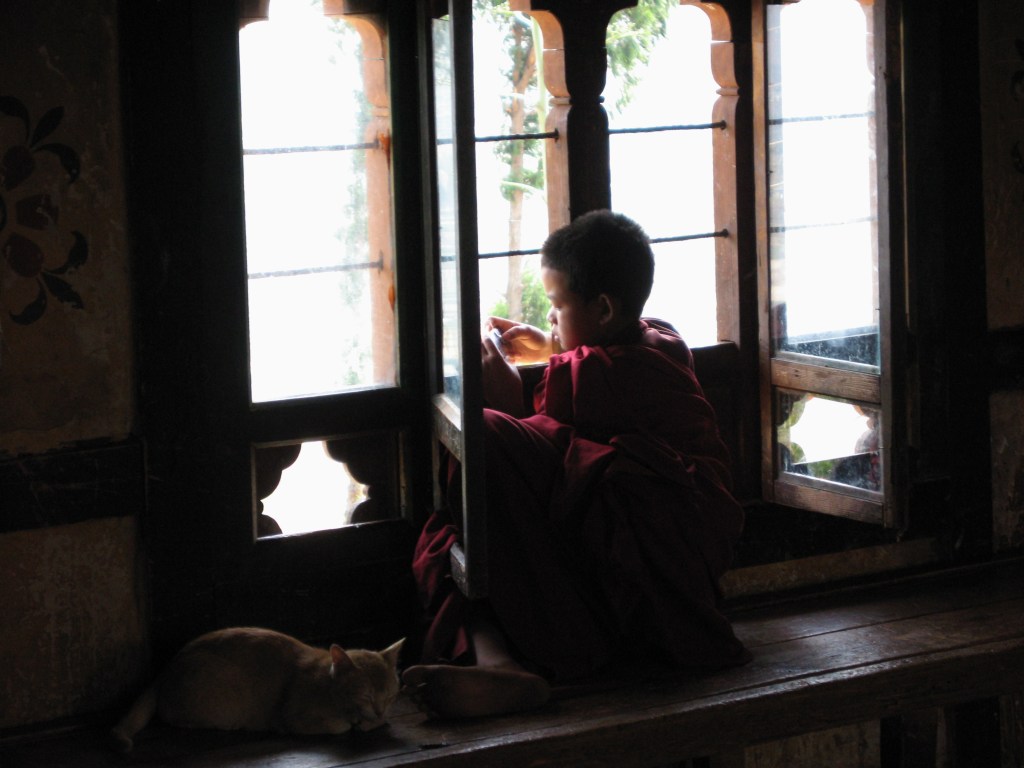
This is the only Country in the World where it is politically correct to paint an enormous dobber, with all the accoutrements, on the wall of your house and, if you do it on your neighbours’, he will thank you for it, rather than call the sex-offenders hotline. Way cool. His Temple, however, was bit of a letdown, but you have to do it, if only to offer up a prayer for divine madness and catch one of the Monkletts playing his Gameboy.
On, on, to visit the Punakha Dzhong. Another huge fortress/monastery built on the confluence of 2 rivers, one male and one female. One; shallow, violent and turbulent, the other; deep, passive and compassionate. Go on, guess. Then imagine me getting whacked round the head, by my missus, for making what I thought to be the obvious distinction.
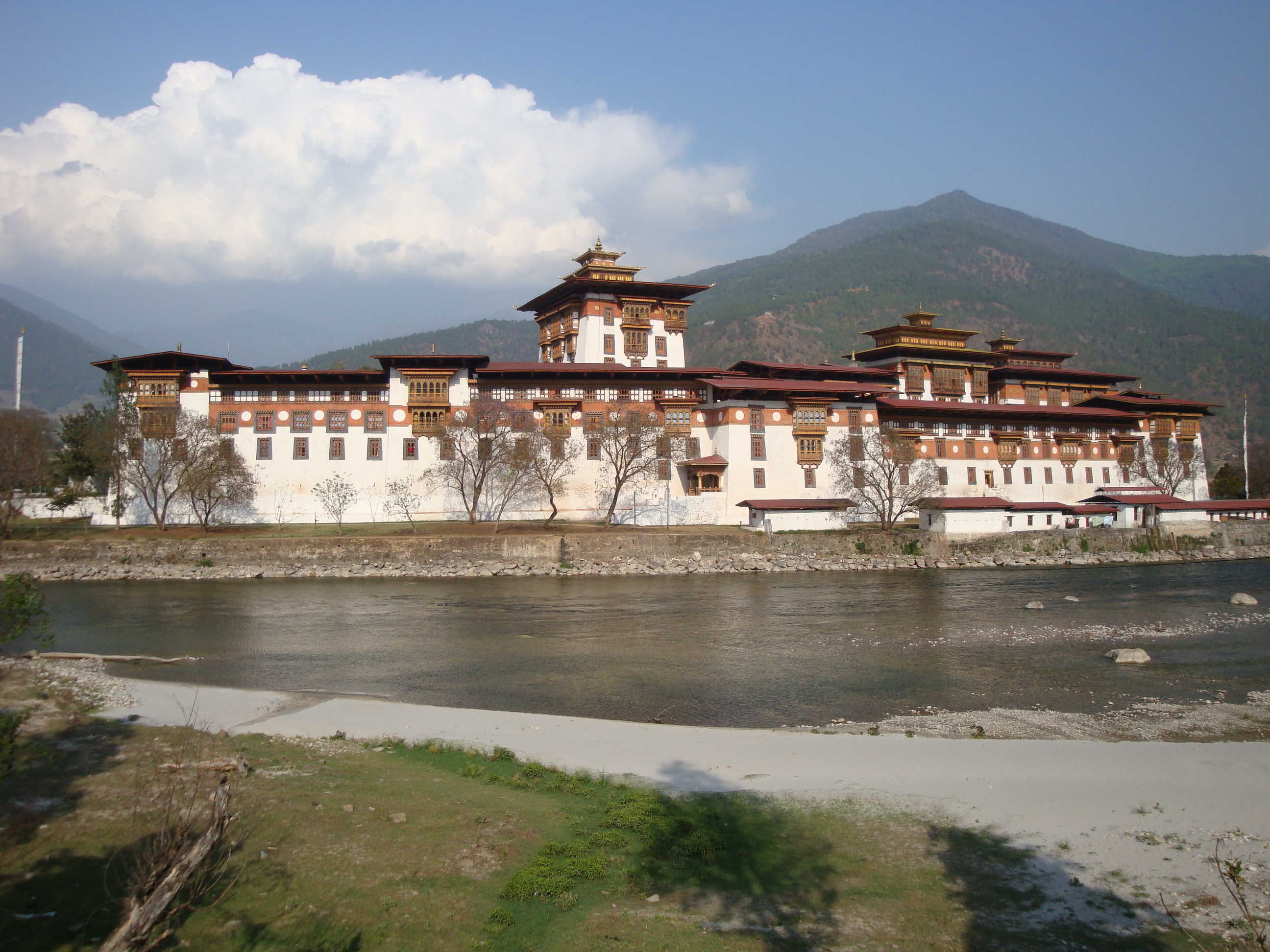
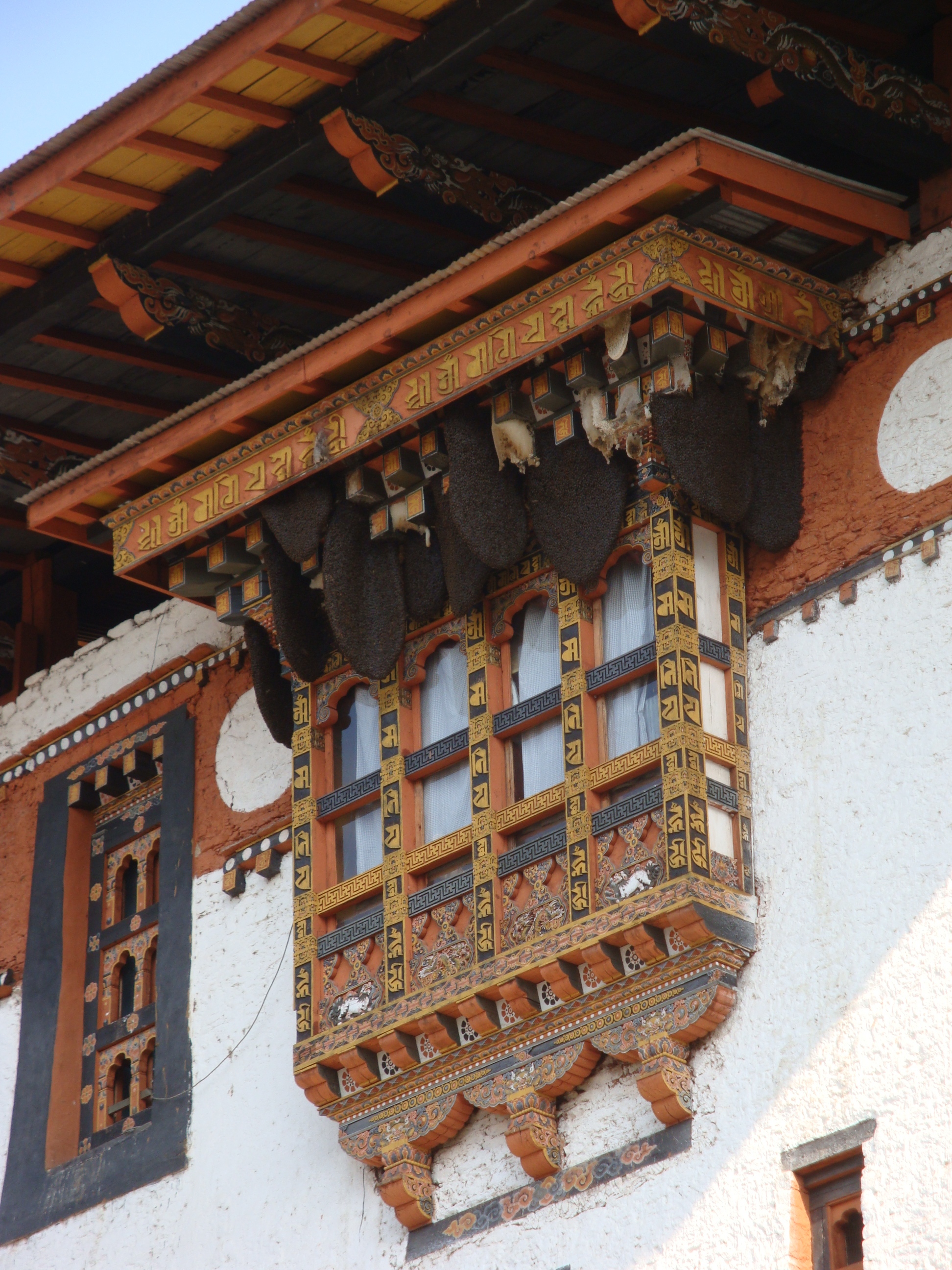
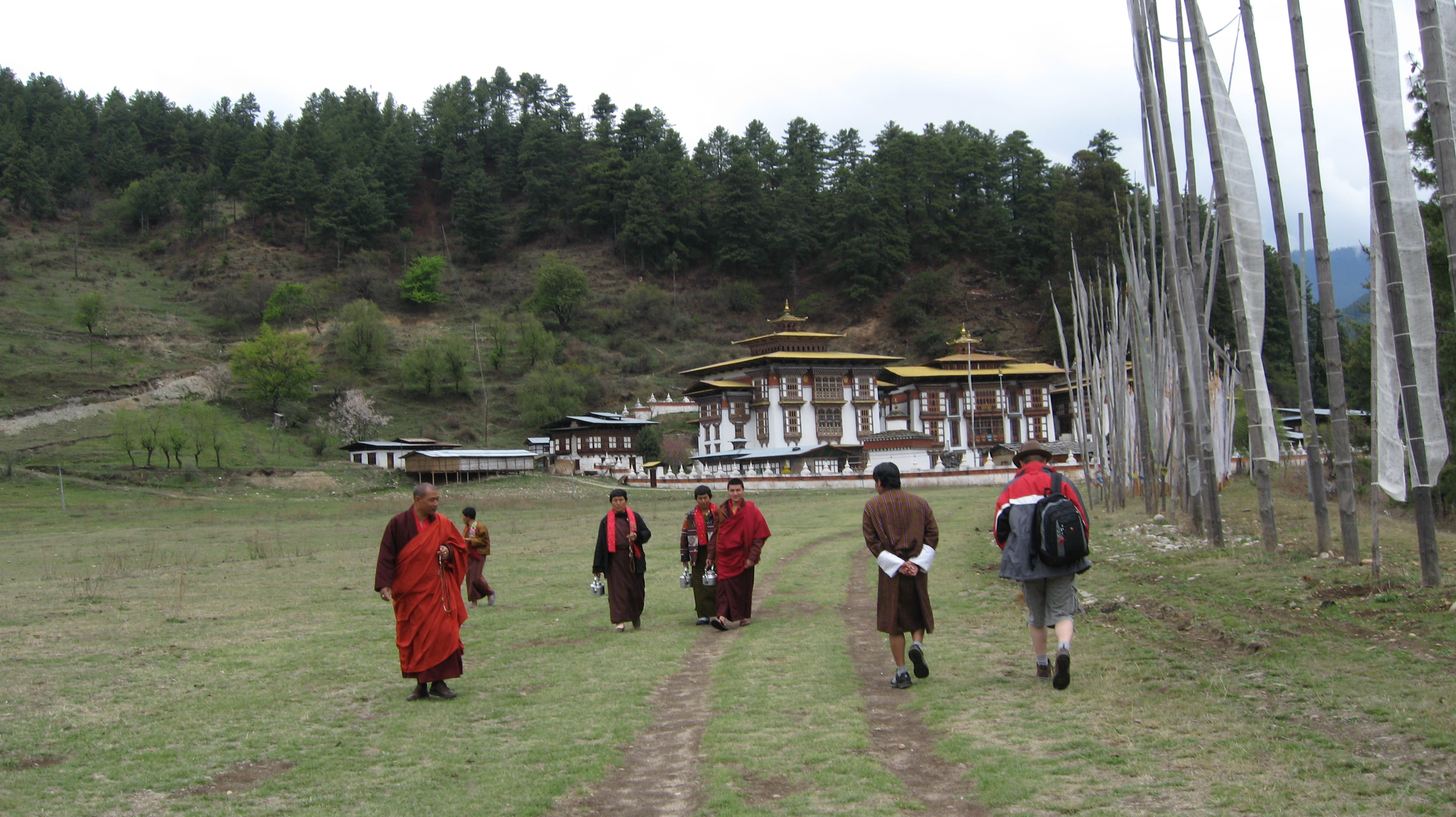
Punakha Dzhong is gorgeous, fronted by water and backed by mountains and framed by Jacaranda trees that just happened to be in violet bloom. We crossed the bridge and climbed the stairs only to be rained on by dead bees. They build their combs in the eaves directly over the stairs. They are massive hives and, given that bees have a fairly short lifespan, they rain little worn out corpses, especially during apple blossom season. The bees are the only successful invaders since 1637, The Tibetans got their butts kicked here twice, although mainly by trickery and deceit. I was beginning to get a handle on the Bhutanese.
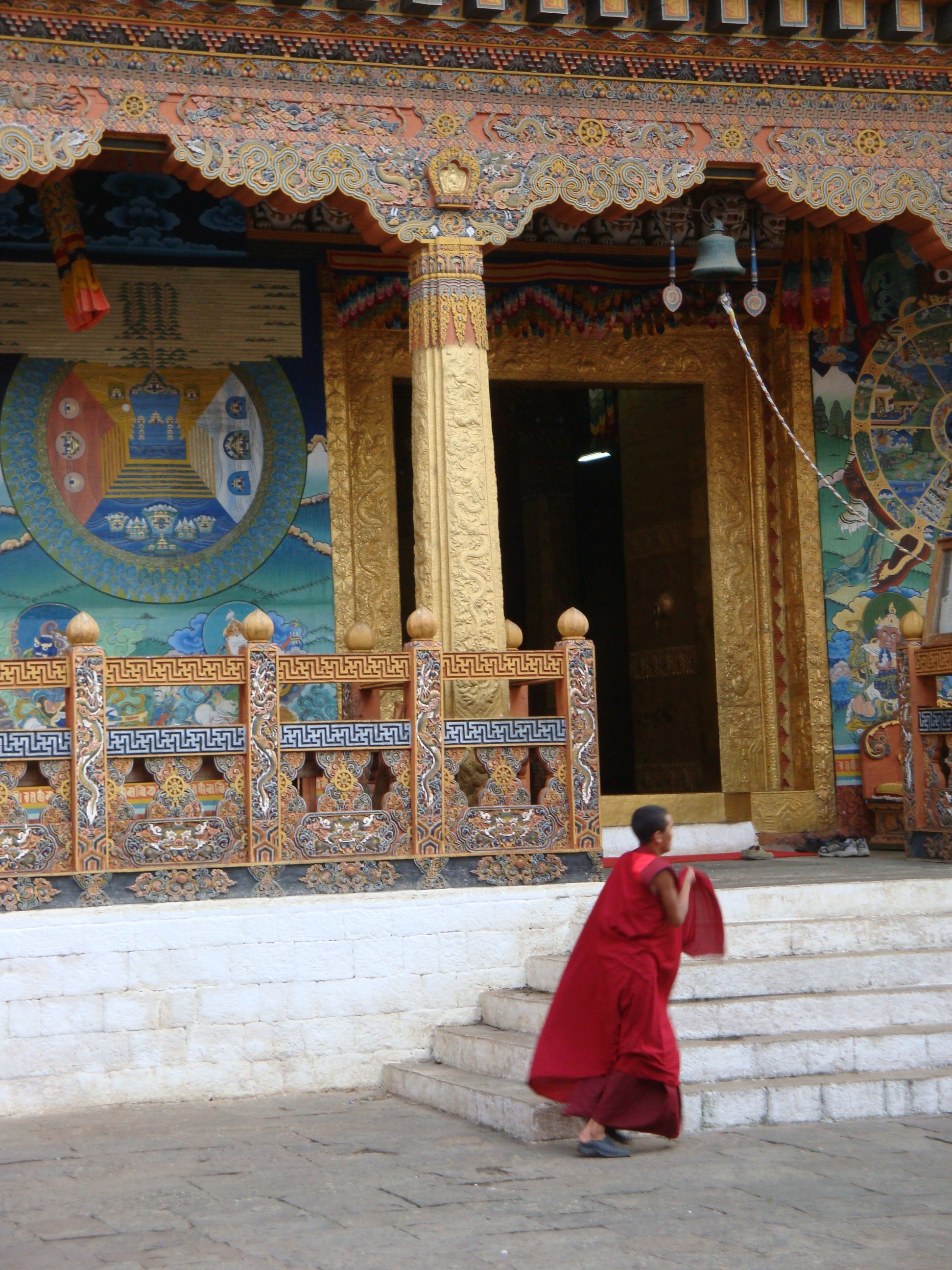
On we went to our Hotel in Wangdue Phodrang, (I’m not making this up), where we had dinner with a bunch of Thais who had driven themselves here via Cambodia, Laos, China, Tibet, Nepal and India. They were barking and it would appear from their behaviour that they have very lax drink-driving laws in all of the above countries.
From here it was a pretty serious drive to our furthest East destination, the Bumthang valley.
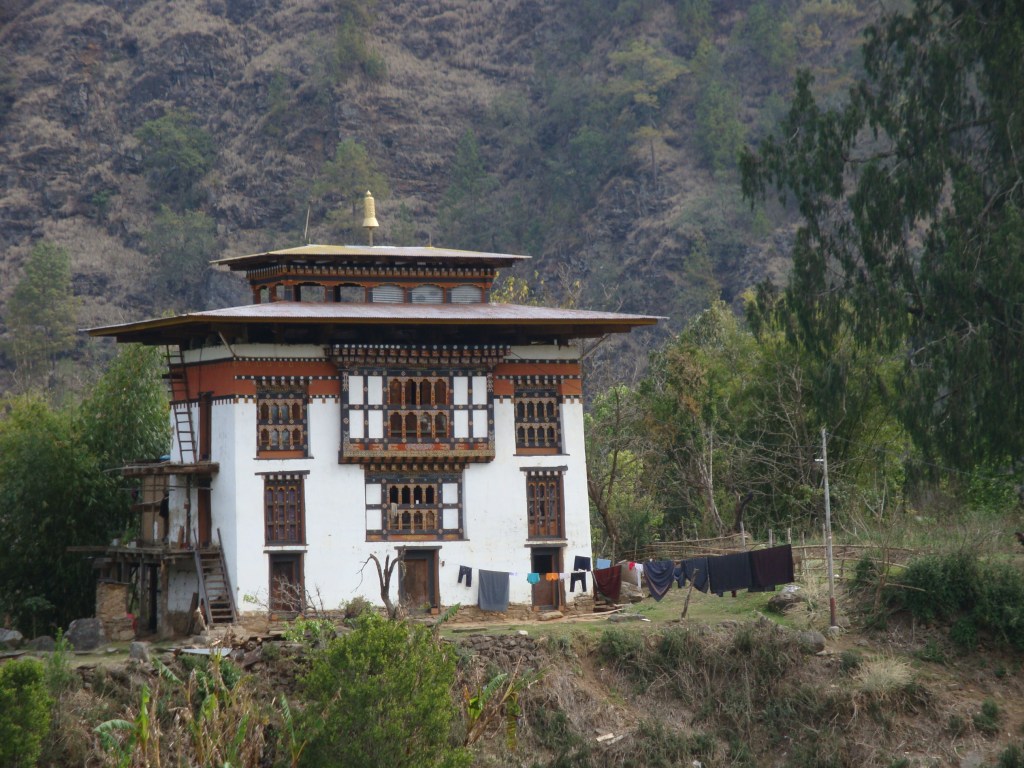
To get there, we had to cross 2 more mountain ranges including the Black Mountains, where we dropped into the Phobjikha valley to see the Nyingmapa Monastery. A bit harsh this one, no matter where you go in Asia, once you get above 3,000metres the people change, get a bit spookier somehow. I didn’t hear a banjo playing in the background, but there was a definite vibe. Lowland people make me feel a lot more comfortable. Phobjikha is also called the Valley of the Black Cranes, but they were not there when we called.
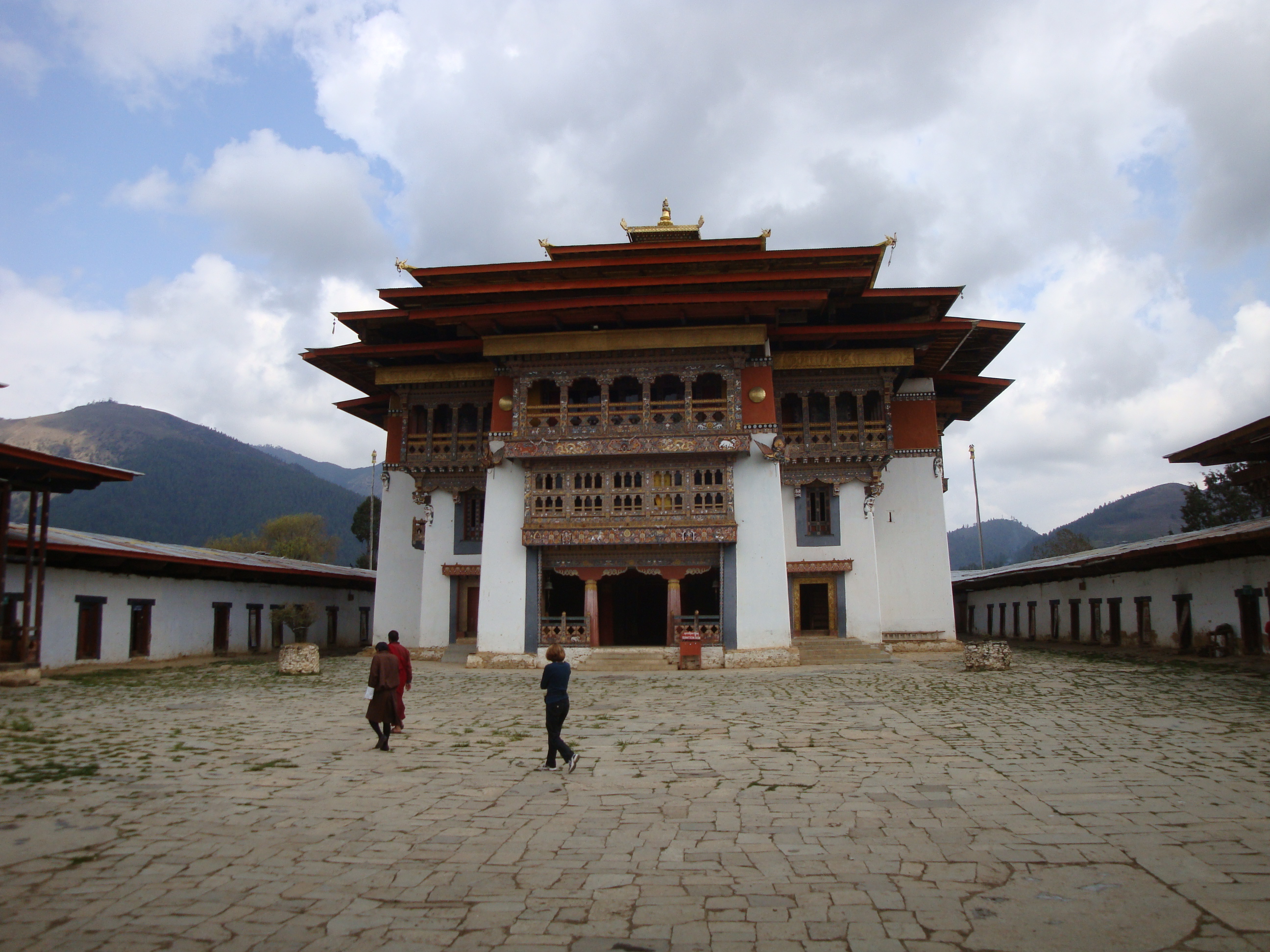
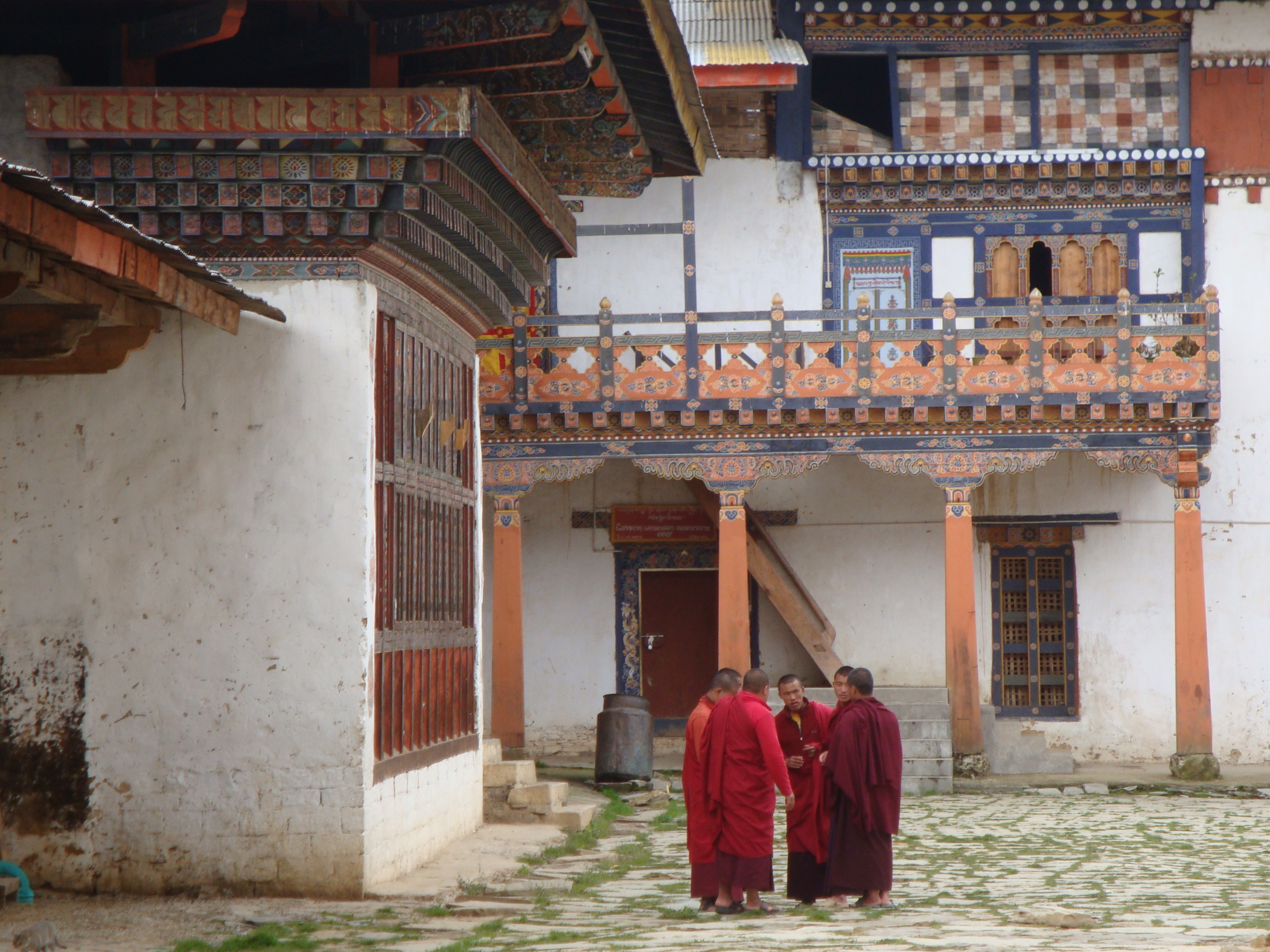
On we drove, through Trongsa with its magnificent Dzhong protecting the route across the river and over the last pass, by which time the weather had closed in and we were wrapped in cloud. The windscreen wipers had been clearing the rain and then suddenly they were clearing ice, pushing great clods of slush with every sweep. The Cedars and Oaks, wrapped in dripping moss loomed out of the mist as we zig-zagged down the mountainside into Chumney and then over into Bumthang.
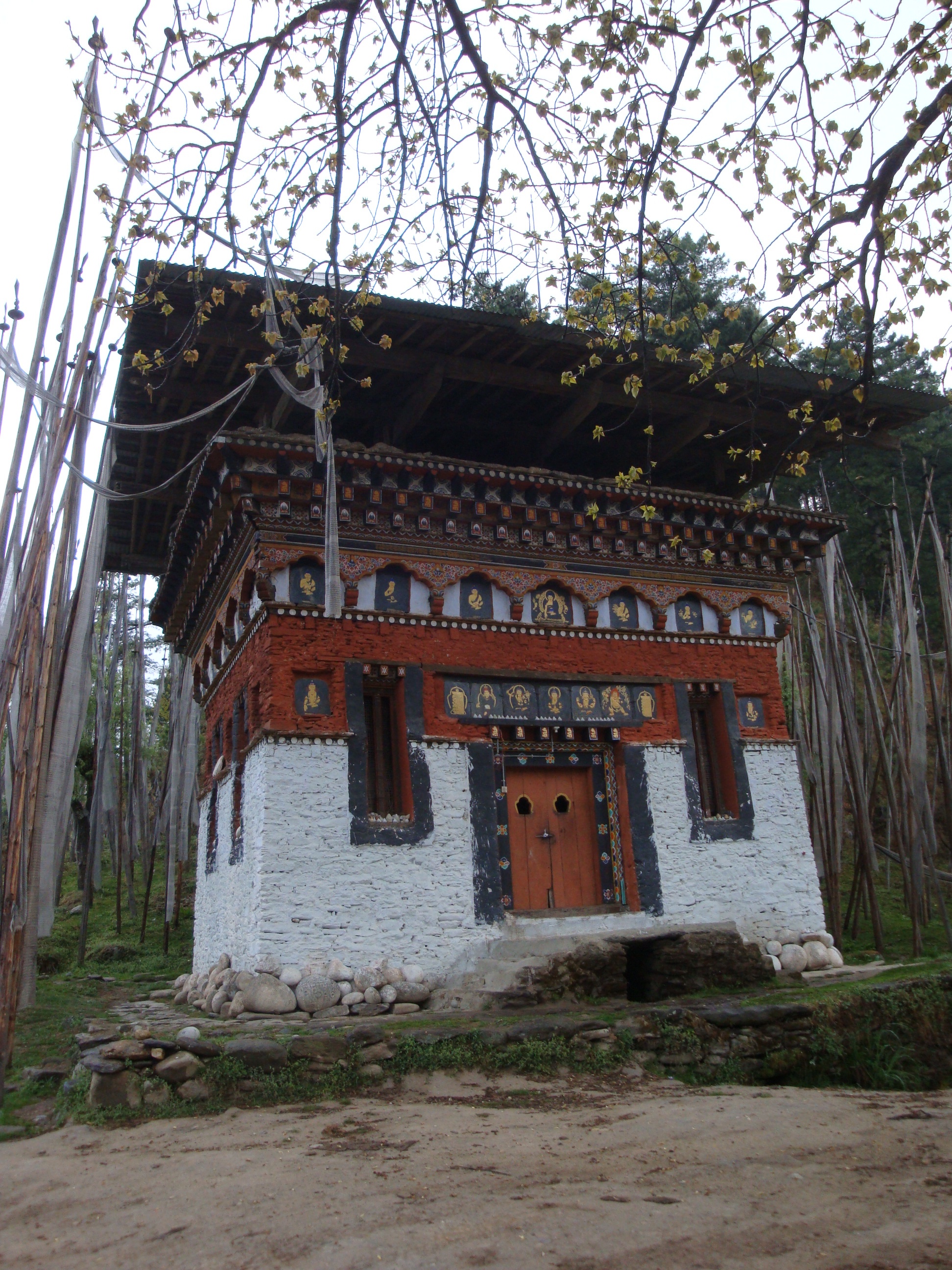
We stayed at the Mountain Lodge in Jakar, unfortunately half of Jakar burnt down last year and just as they got most of it fixed, half of the other half went up as well. Evidently someone hadn’t been pulling their weight in the Demon Appeasement Dept. So it seemed a bit frontiersville but it was okay.
At the top of our road was a beautiful big house containing a huge water driven prayer wheel and surrounded by vertical white prayer flags. We saw these everywhere. Mostly, pretty little whitewashed houses with decorative roofs and windows, set above a stream which runs underneath and turns a paddle that spins the prayer wheel inside.
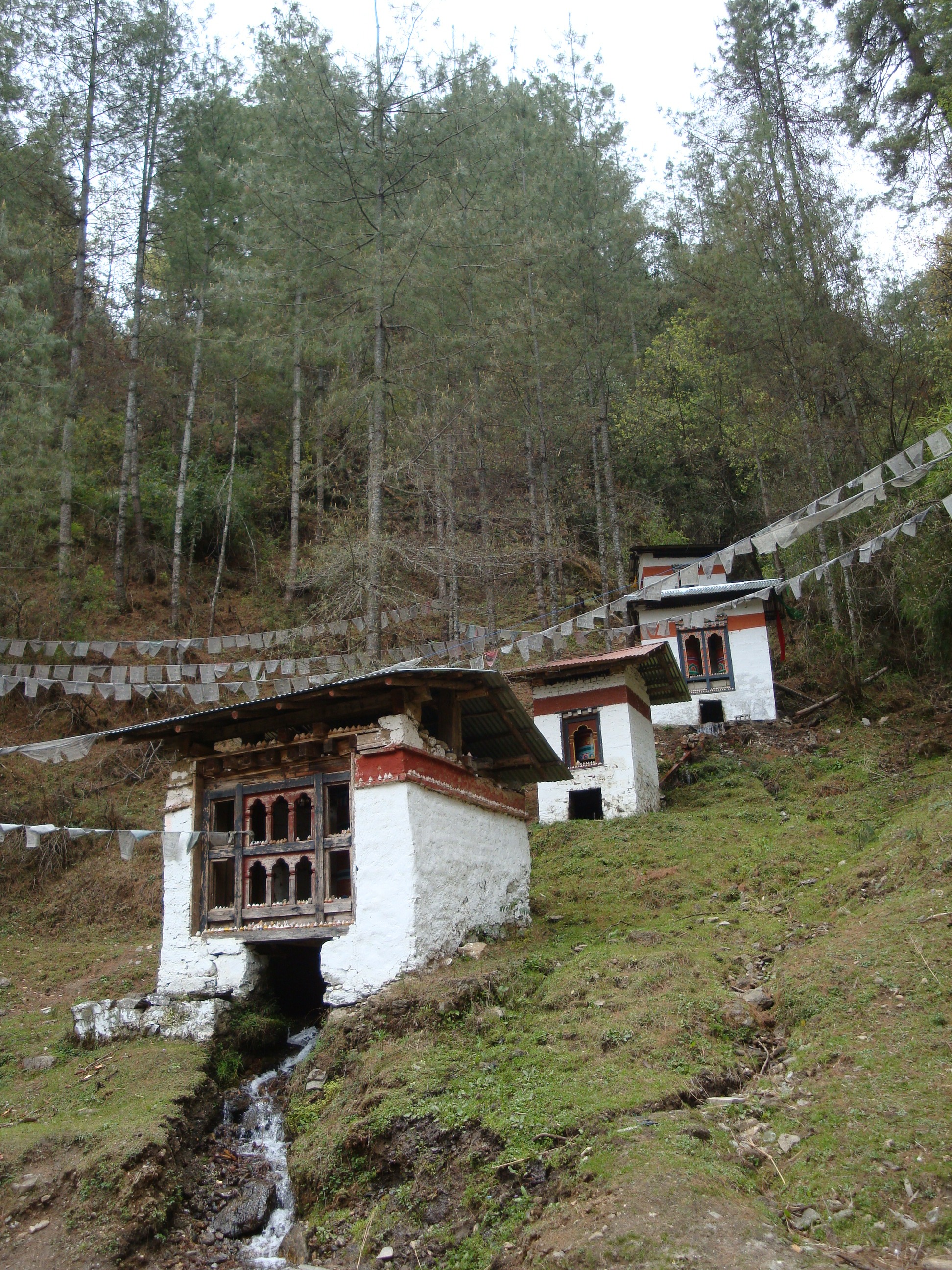

They don’t use these for grinding corn, husking rice, driving mechanical looms, or generating electricity, but boy do they ever get a lot of prayers said. The tall white prayer flags on forests of poles are everywhere, round the temples, up on mountainsides and outside the local Pool Hall. The weather was still a bit miserable, it was cold and wet with low cloud, but after we had a bit of a walk round what was left, we went back to our rooms where the staff had lit our wood stoves. Mosty-toasty. A bottle of wine and a big feed of ferns and we were back on form.
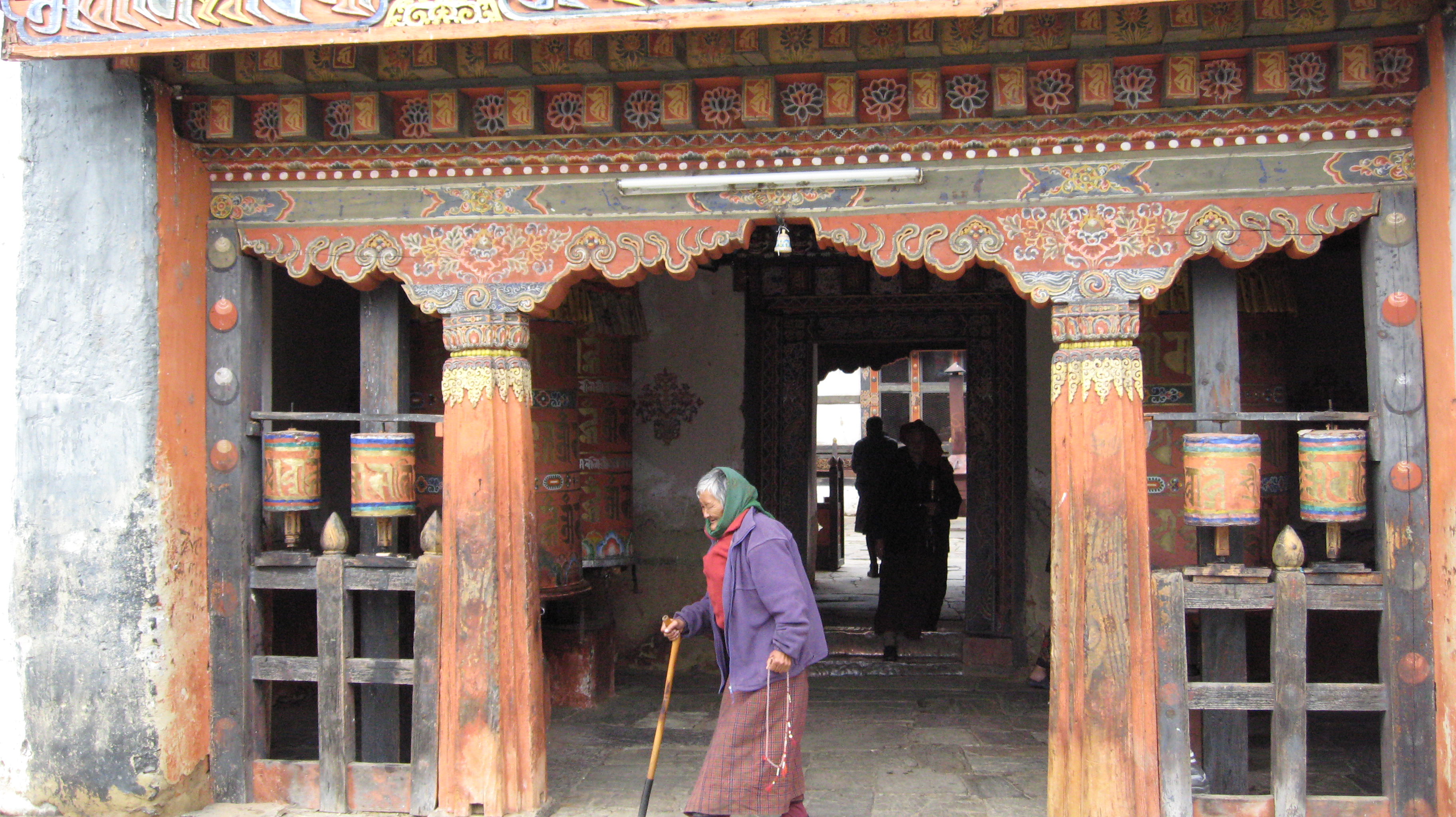
The next day we walked up the valley to the Jampey Lhakhang, the oldest temple in Bhutan (7th Century) and some of the gadgies walking around the outside looked as if they had built the place. The Temple is located on the left knee cap of a huge, supine Demoness whose navel is under the Jokhang Temple in Lhasa, Tibet. Bhutan is famous for its festivals and the Jampey is famous for its Fertility dance with everybody jumping through a bonfire arch and then the Naked dance which takes place at midnight. All very Buddhist. Goh figure.
As we walked on to the next temple, my eye was caught by a pretty little weed growing wild along the trackside. “Tensing, is this Cannabis Sativa?”. “Oh, yes”, he replied, “But it’s against the law to smoke it”. Yeah right. Suddenly all these dressing gowns, Divine Madmen, supine Demonesses and Ogres flying on the backs of tigers, began to take on a weird sort of rationale. Goh figure.
Fortunately for Bhutan, those days are far behind me and I decided not to gather an armful of these aromatic herbs to dry out on our wood stove. Anyway, we had already bought a bottle of Indian Vodka called “White Mischief”, which was causing quite sufficient damage thankyou.
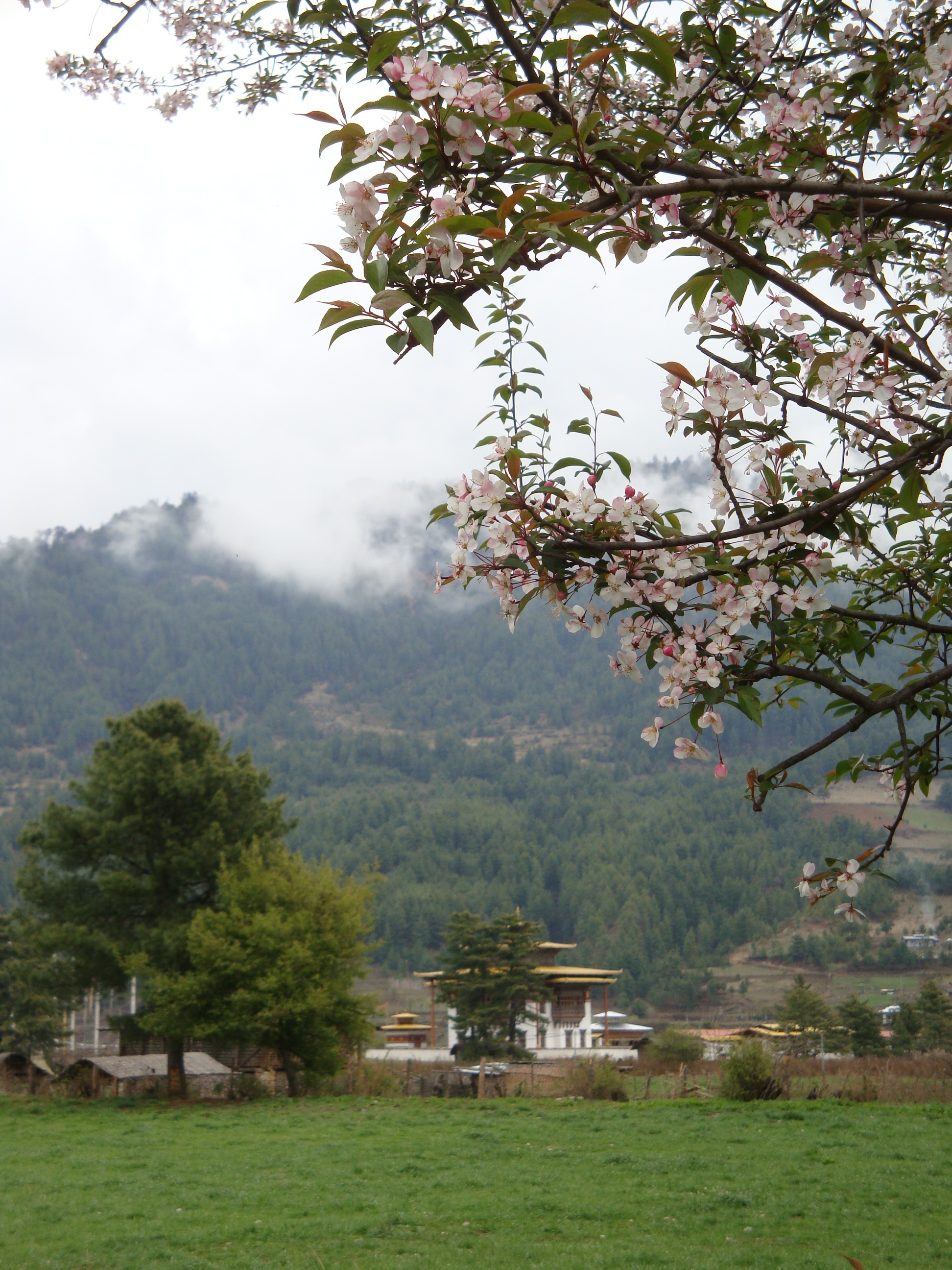
On past apple orchards in clouds of pinky-white blossom to a new temple built by one of the Queen Mothers to honour her father. Inside was a representation of Buddhist heaven. I’m telling you that somebody had to have been on weed burning duties on the day they made that. Then to the Kurjey Lhakhang where you get to crawl through a grubby little cave to cleanse your sins and see the body print of Saint Padmasambhava. He subdued a local demon by meditation and the power of this meditation imprinted his outline in the rock behind him.
Walking on, we crossed the foaming river on a very wobbly suspension bridge with several, very dodgy, rotten planks. When I pointed this out to Liz and gave some of them a good boot to prove my point, she got all hissy with me.
Through more blossom filled orchards to Tamshing Lhakhang built by one of the great Treasure Finders, Pema Lingpa. He was a dude who went round discovering relic treasures which had been secreted round the place by Buddha in order to revivify the religion whenever it needed it. This guy was a Monk, a Warrior, an Engineer, an Architect, a Blacksmith, a Sculptor, a Painter and a Treasure Hunter and he was tiny. A sort of 16th Century Tom Cruise, only less weird.
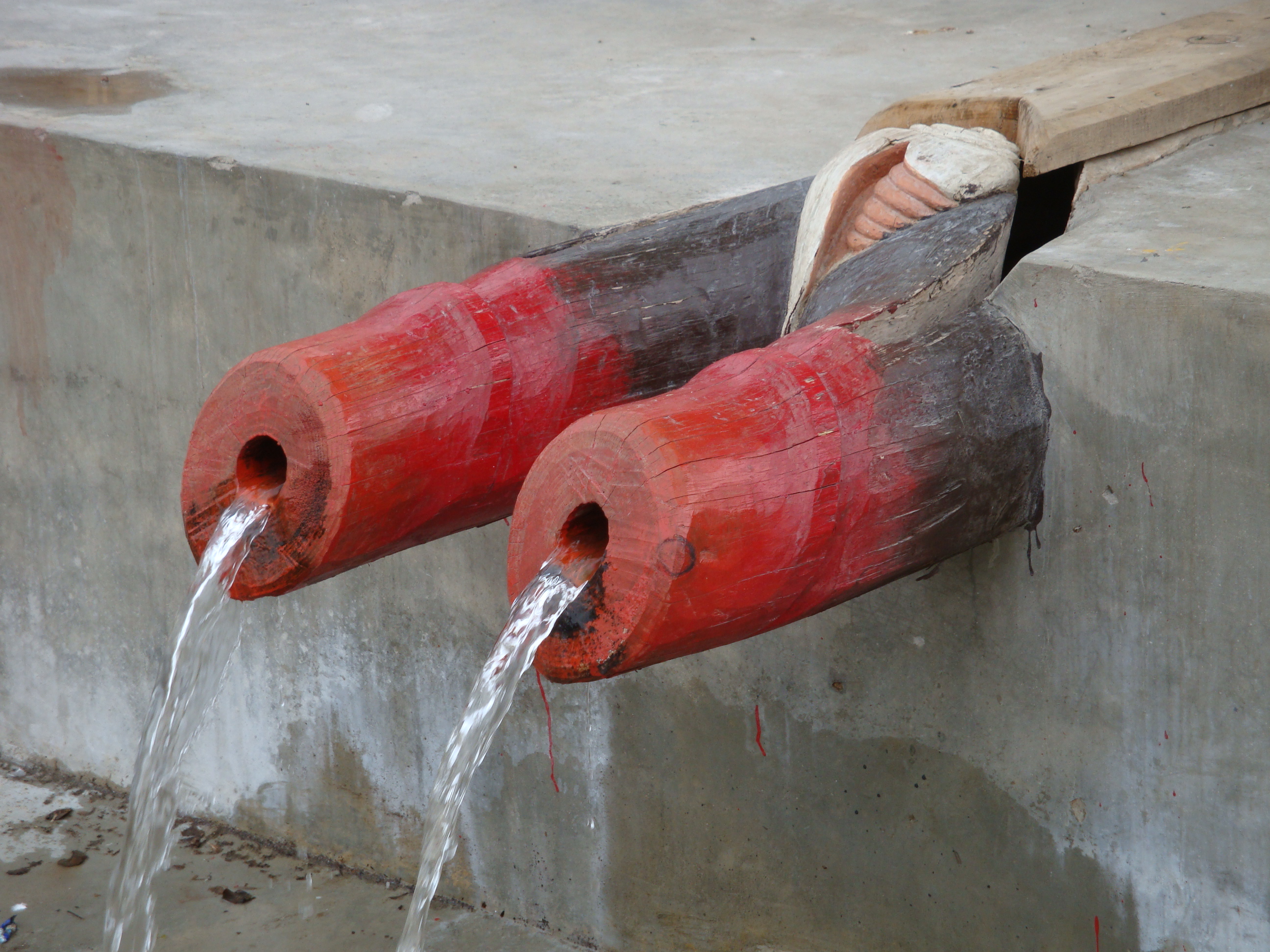
In the courtyard outside his temple was a very pretty, water driven prayer wheel with two outlet waterspouts in the form of big red willies. Inside the temple are some of the oldest wall paintings in Bhutan and sitting on a stone is a pile of chain mail. This was the original chain mail cloak fabricated by Pema Lingpa himself, 500 years ago. It weighs about 25kg. If you can lift it up and put it on by yourself, then walk around the inner temple three times, you are sure to gain merit. Perhaps you will also gain a dislocated shoulder. I suppose it’s supposed to be a mystical experience but, inevitably, it turned into a race against the stopwatch. Despite a seriously damaged shoulder Dori insisted on having a go and clocked a respectable time as well as bags of merit.
We bypassed the local brewery, which makes a very yeasty, rice brew but stopped to buy some local cheese (Sold out, come back at 5.00) okay some local honey then (Sold out, come back in August). Checked out the local paper maker who made beautiful paper from Daphne fibre, but his prices were horrendous. There seems to be an idea creeping in, that if you can afford to come to Bhutan, you can afford to pay top whack for anything you buy there. Maybe, but if I can get exactly the same paper in Bangkok for a quarter of the price, then why would I? Also, they cook their paper sheets on great big electric hotplates, in a country where the sun will burn a hole in the back of your head most days.
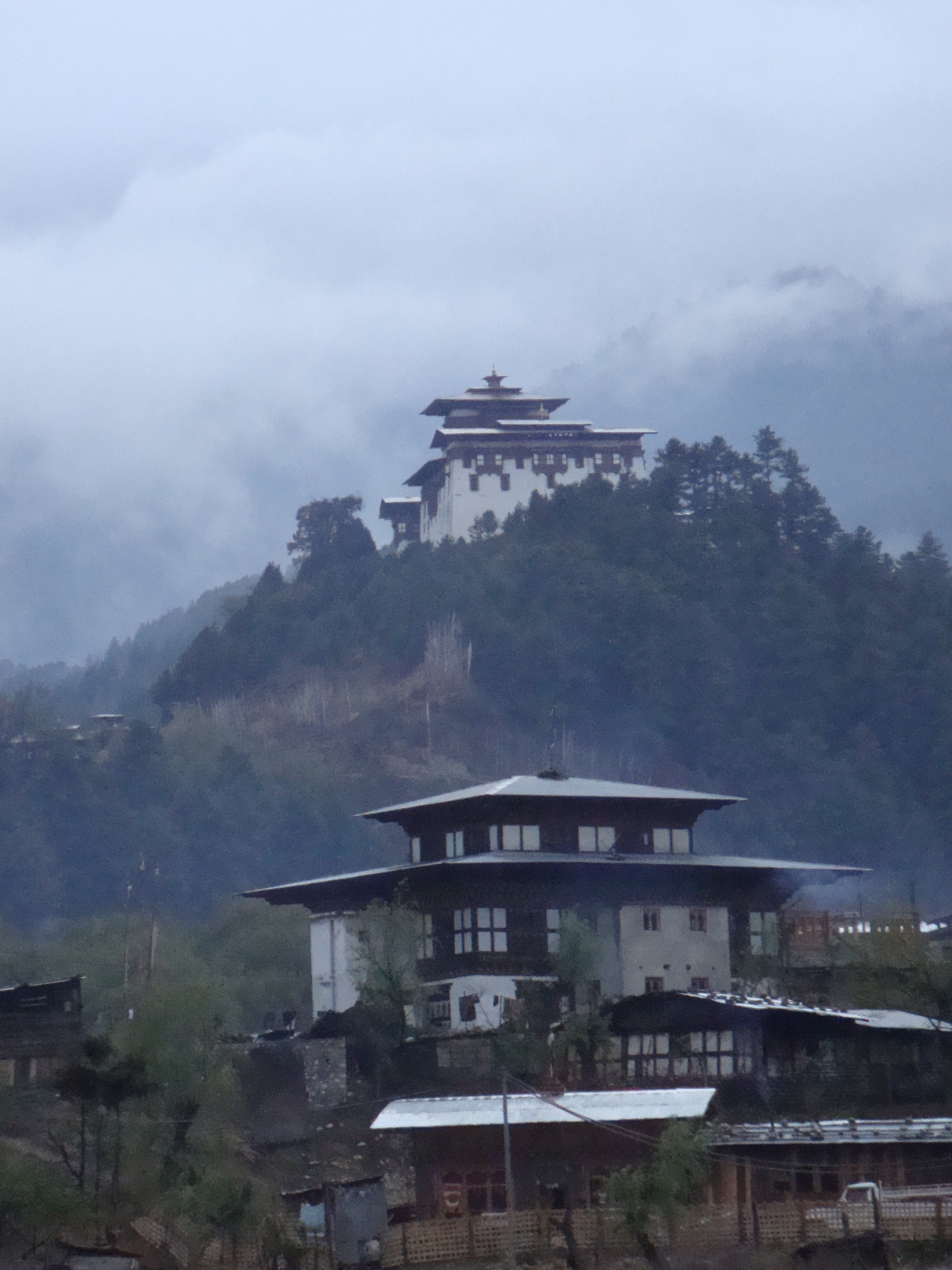
Lastly up to a privately run Monastery with beautiful views over the valley to the Jakar Dzhong looking all mysterious, half in the clouds, up on the wooded hill above the town. We looked into the Monastery kitchen, a black hole where the young monks were cooking dinner, which seemed to consist of cabbage soup.
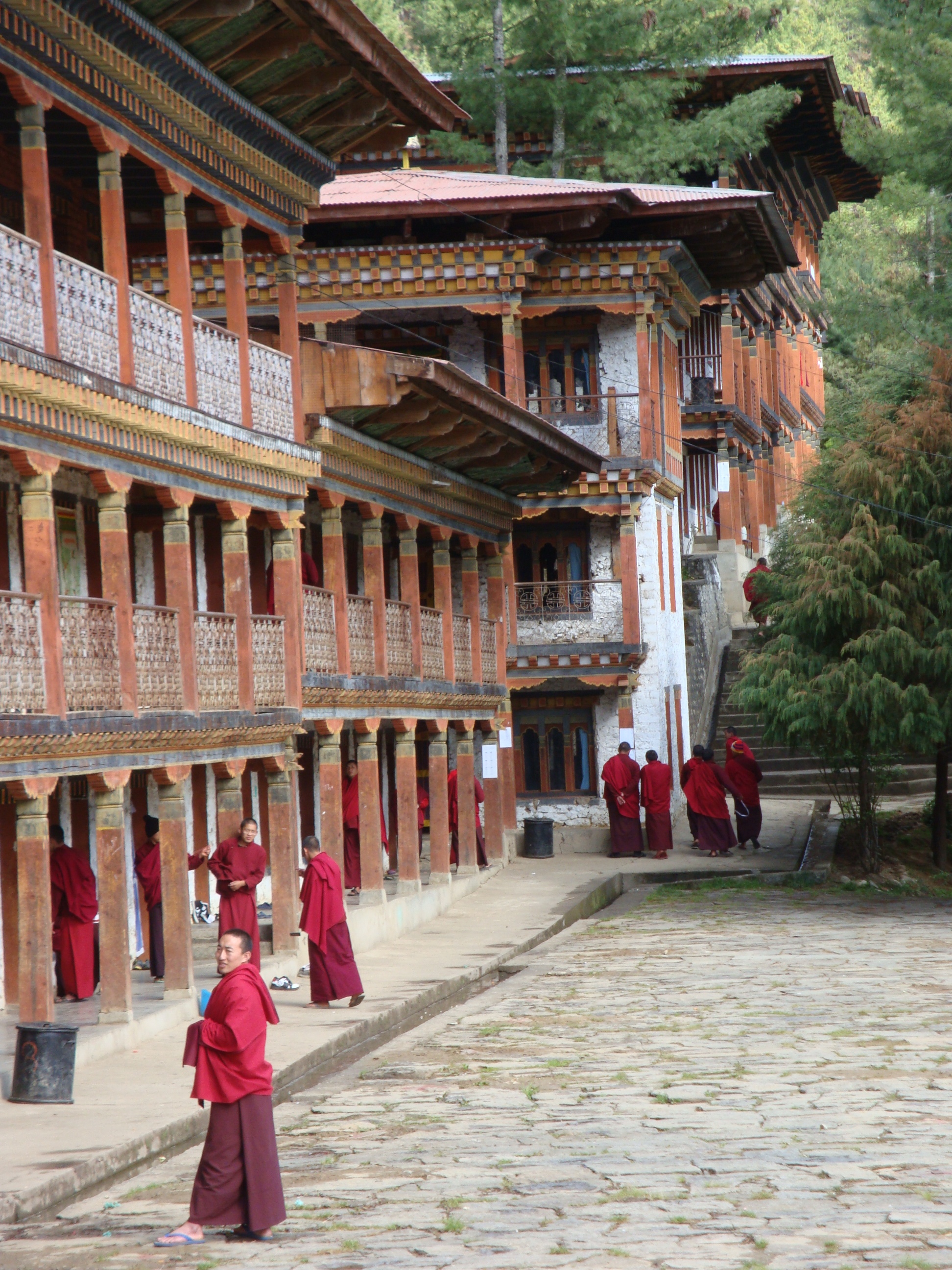

A young scruff of about 12 was hacking away at cabbages and trying to wipe the snot from his nose with his sleeve. This didn’t work and just left a great glistening string from his nose to the pot. So then he opened his robe and had a good snook into the lining, but that didn’t do much better and by this time it was difficult to see where the soup began and the snot finished. Liz reached in through the window and gave him a tissue, but all his mates were just cracking up and, I guess, saying in Dzongkha, that it all added to the flavour. We had a very nice mushroom soup at the hotel that night.
Dori and I took an evening stroll up to the Jakar Dzhong and passed a group of junior policemen playing Lawn Darts. Not your namby-pamby Western style. These things are pointed with 4inch steel spikes and they hurl them 60 yards at a tiny little wooden target. This is war as sport.
Walking back to the Hotel we passed the school, all the kids coming out in their dressing gowns, having stayed on late to watch ‘Sleeping Beauty’. At bit tame I would have thought after what they get taught in R.E.
In the morning, the sun decided to come out and we went to the Burning Lake. This was a place where Pema Lingpa jumped into the water with a lighted lamp, found a cave with an old woman, was given a reliquary and then appeared back on the bank with his lamp still lit. Harry Houdini, eat your heart out. Unfortunately, in the wet weather on the day of our arrival, an Indian tourist had taken a slip into the Burning Lake and didn’t find the cave or the treasure. They found him several hours later, locked in a whirlpool. When we got there, it had dried out a bit but the rocks were very steep and the Lake (Actually a river a bit like the Strid) very deep and the blooming prayer flags so thick you had fight your way through. Poor bloke probably got entangled and tripped.
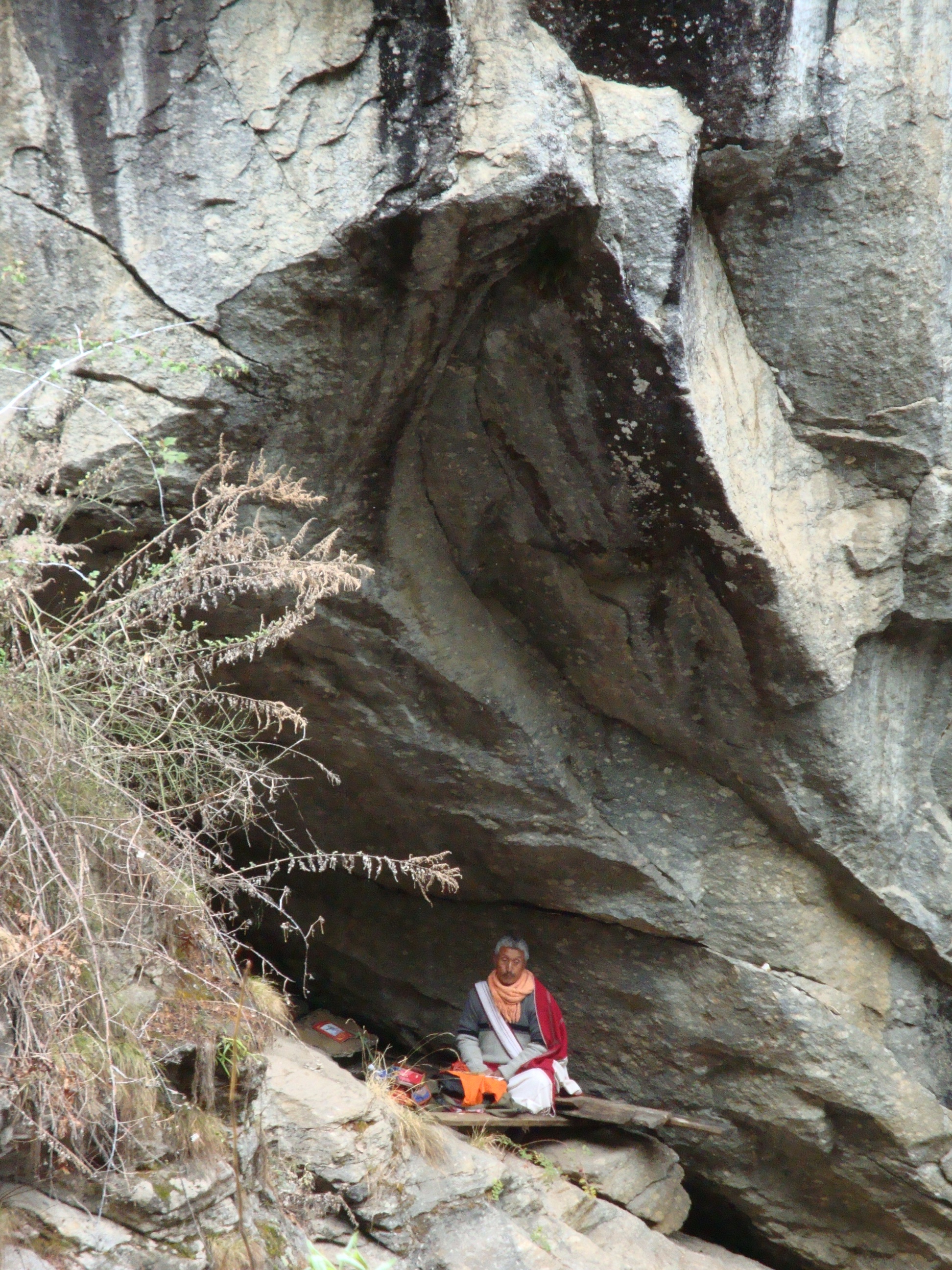

Even so, there was a monk on a ledge, in a cave, chanting his mantra in this lonely spot and the atmosphere was ethereal.
We left Bumthang and headed back to Trongsa. After the rains, the sun had come out and the new snow on the mountain tops, sparkled against an azure sky, so bright and crisp it could burn your eyeball.

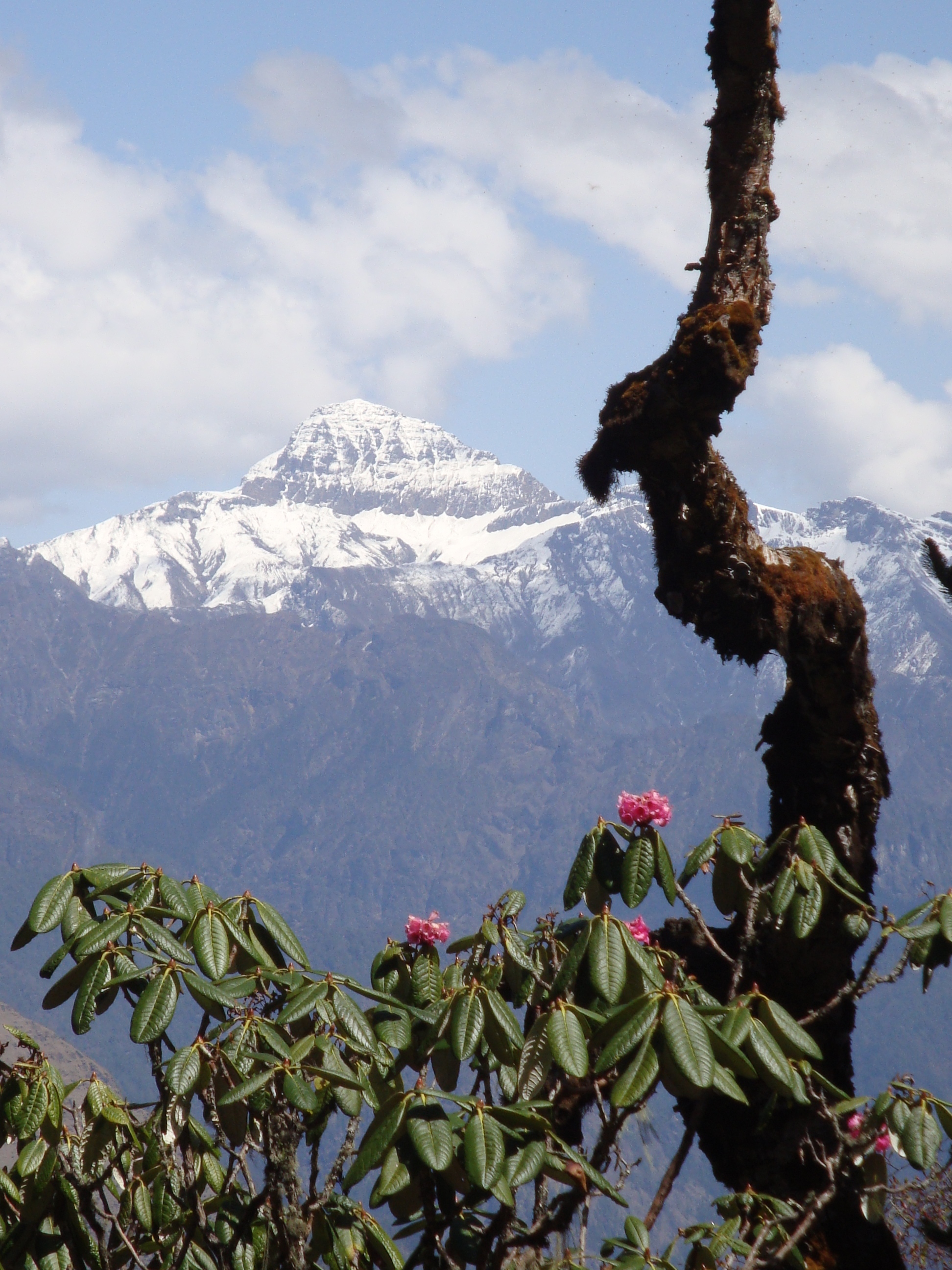
Over the pass and down, we stopped at Trongsa Tower, a fort situated above the main Dzhong that has been turned into a very good Museum where we were able to learn even more about the beloved King, his textiles and, of course, Buddha. Now there was quite a bit of text here and several of the statues of Buddha, Reincarnations of Buddha, various Gods, Deities and whatnots appear to have a lady attached to their front. She has one arm round the blokes neck and one leg wrapped round his back and, according to the text, is the relevant Deities’ Consort. This literally is his other half, his female side, and their union is a spiritual one used to describe ‘Oneness’. The fact that the statue shows their attachment in very graphically intimate detail, should in no way be interpreted in a carnal manner. Same as with the willies on walls, it is not schoolboy smutty, it has deep religious symbolism. Straight up. Whoops! Perhaps that’s not the right phrase to use in the circumstances.
Over in one of the turrets, so we were told, lives a monk who has committed himself to a lifetime of seclusion in order to achieve enlightenment. Good for him. Free room and board, his brother brings him his supplies every week and leaves them at the door. He hasn’t met a single person in 27 years and he will stay there until he dies. So that he can achieve enlightenment, for himself. Not you, not me, not World Peace or an end to poverty and disease, not for anything but himself. Sorry but doesn’t that strike you as a bit selfish? It did me.
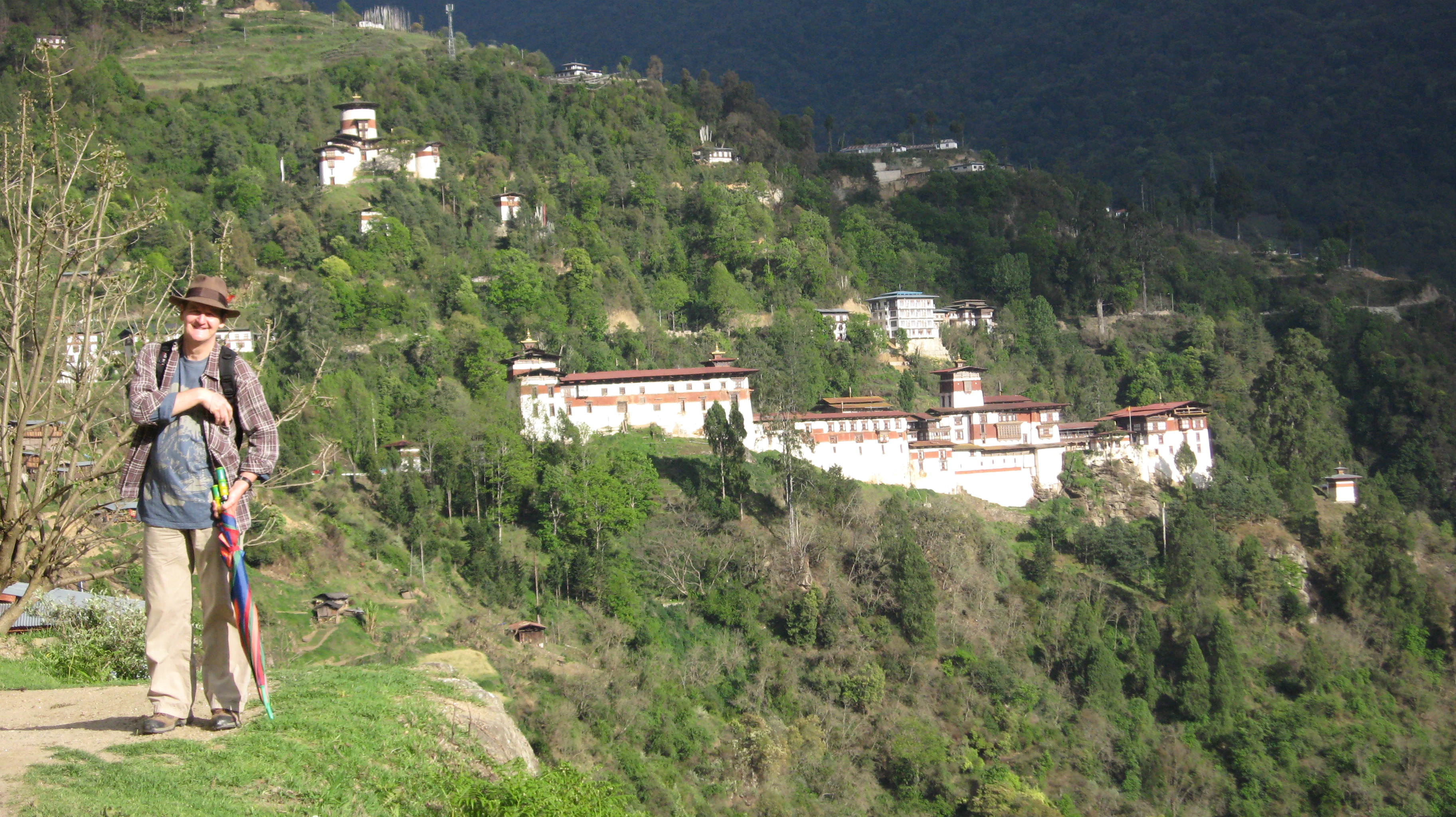
We had a look round the main Dzhong which sits astride the track that used to be the main East-West road. A convenient way to ensure that everybody on the move, had paid their taxes first.

Next day, back to Wangdue Phodran Dzhong, more monks, temple-forts and a cracking painting of dancing skeglingtons.


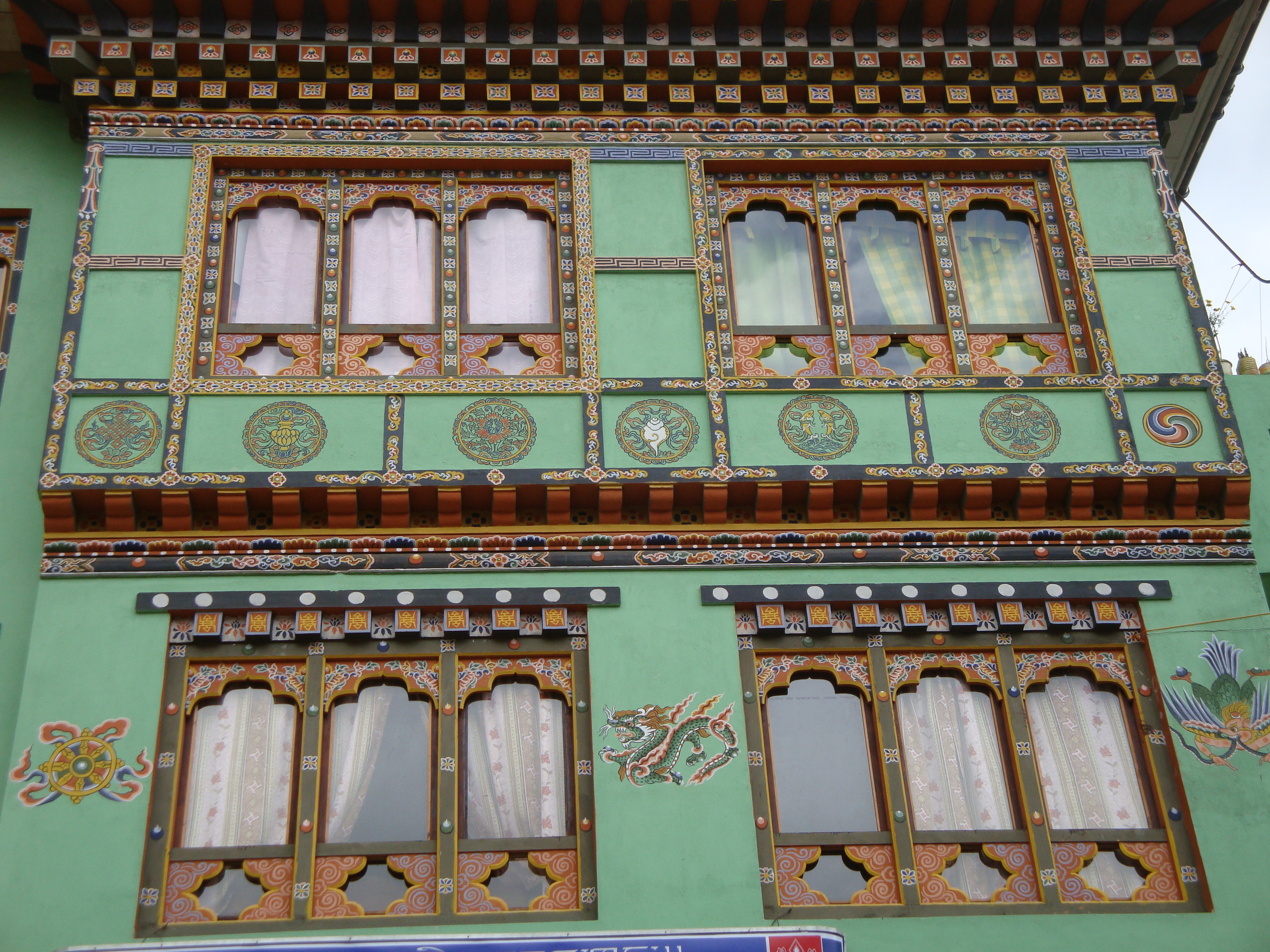
They are knocking down the old town, because what used to be convenient is now overcrowded and they have built a big new town, with big new versions of old houses, complete with big new paintings of Garudas, Phoenix, Dragons and a rather fine Masturbating Monkey. Goh Figure.

On-on, back over the mountain ranges until we skirt Thimpu and head for Paro. This day took 10 hours to cover 200k, going as fast as the roads would allow us.
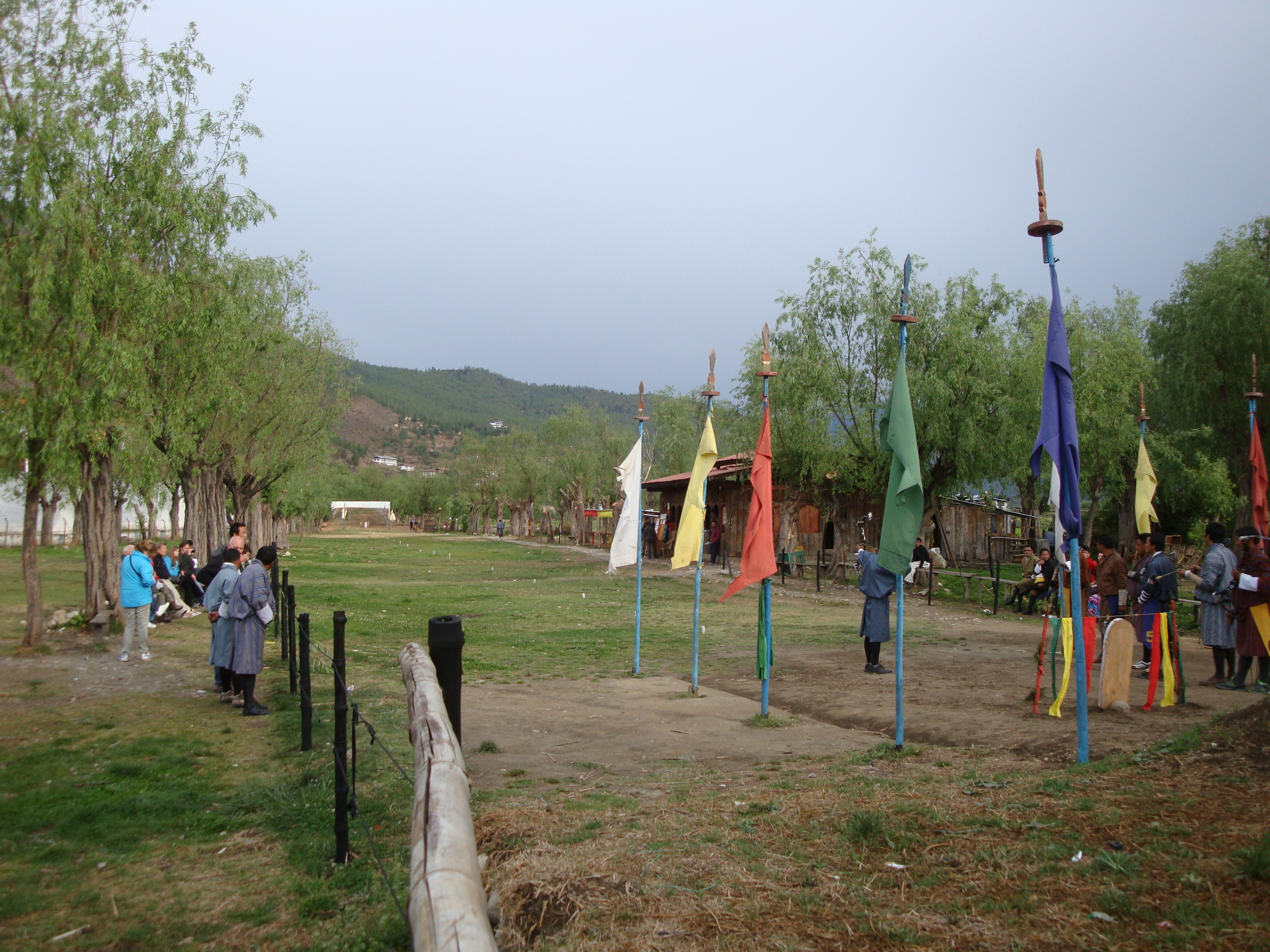
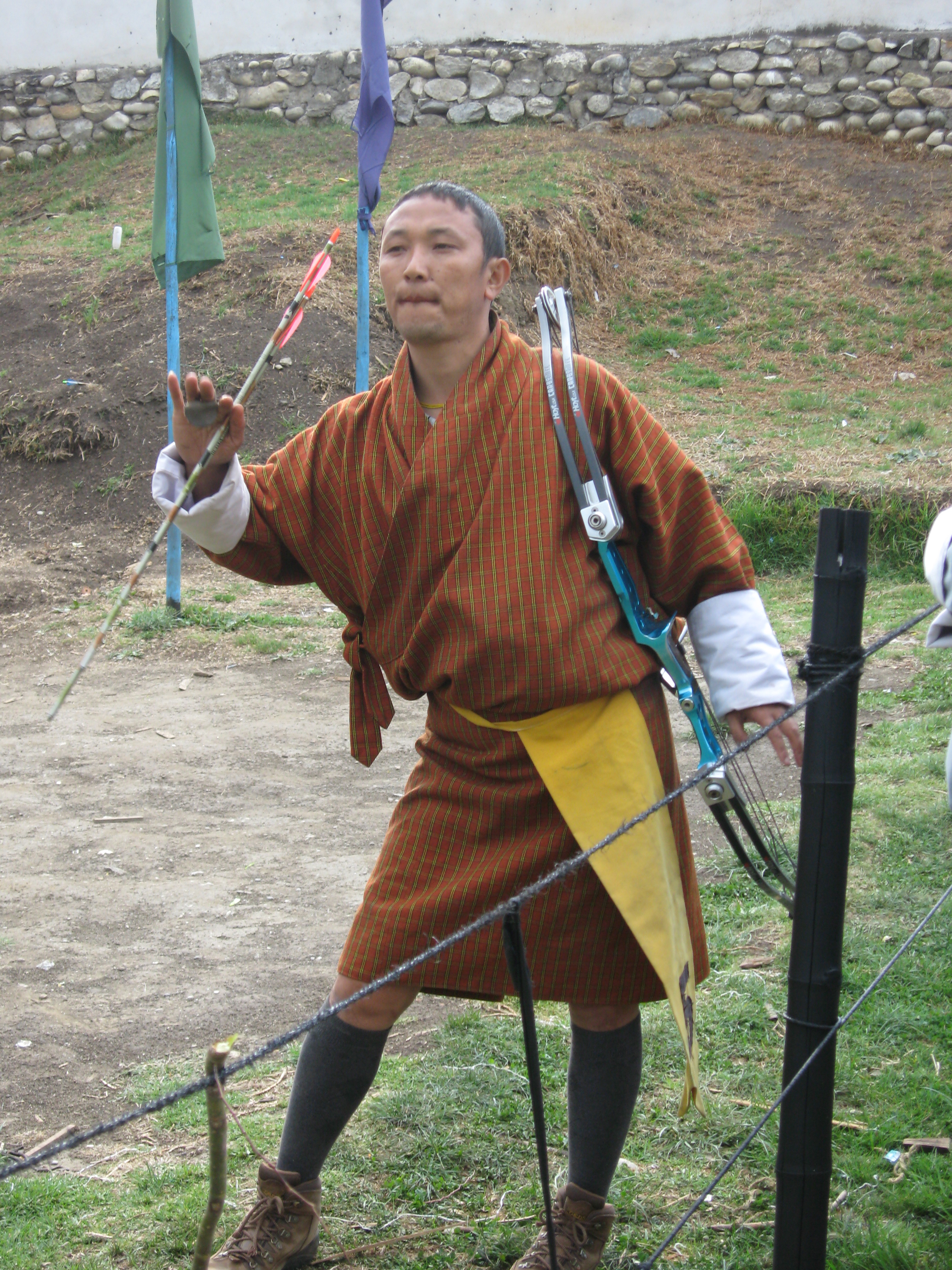
We arrived in the evening and stopped to watch a bunch of blokes in dressing gowns shooting arrows 160 yards at a target as big as a set of cricket stumps,…. and hitting it. The spectators line the sides of the range and pray that none of the contestants sneeze.
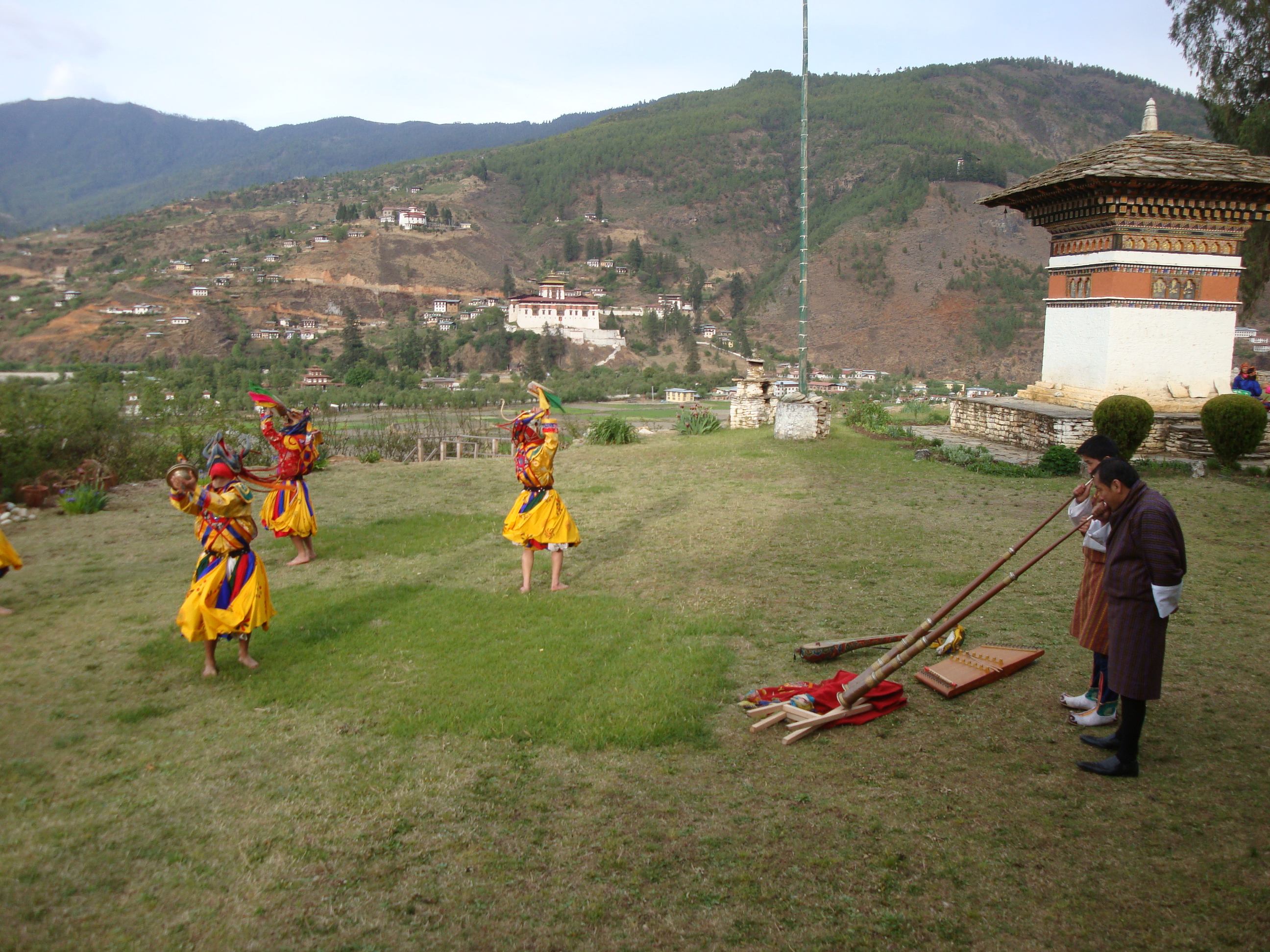
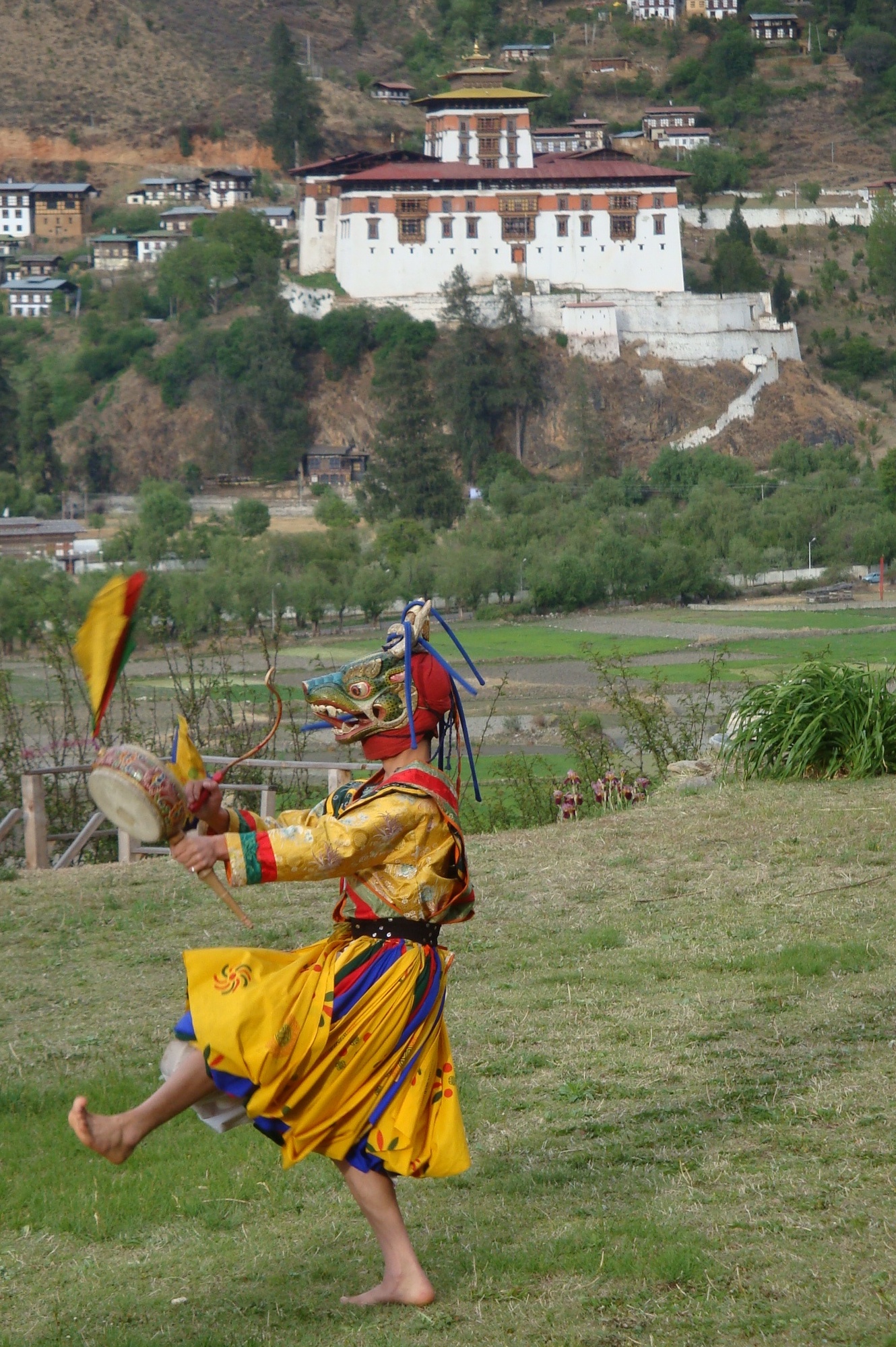
Our Hotel is called the Gantey Palace and actually is a retired palace, with cute little rooms, views over the valley and traditional dancers performing on the lawn. Really good.
Up in the morning and into the van, a clear sunny day with big fluffy white clouds. We drive up the valley and park in the woods at the bottom of a mountain, looking up, two thirds of the way up a sheer mountain cliff, perches Tiger’s Nest Monastery. From here it’s just a white dot. Guru Padmasambhava, or Guru Rinpoche as he is commonly known’ flew here from Tibet, surfing on the back of his girlfriend, who had taken on the guise of a flying tiger. A bit like Dori on a Saturday night. The Guru had come to meditate into submission a local Demon who had been causing trouble and, when he had, he turned him into the protector of Buddhism and the valley. Sounds improbable? Not after you have seen this place.
We set off into the woods and pass a group of prayer wheel houses over the stream and then start to climb and climb and climb. Close to the top, we stopped for tea and biscuits.

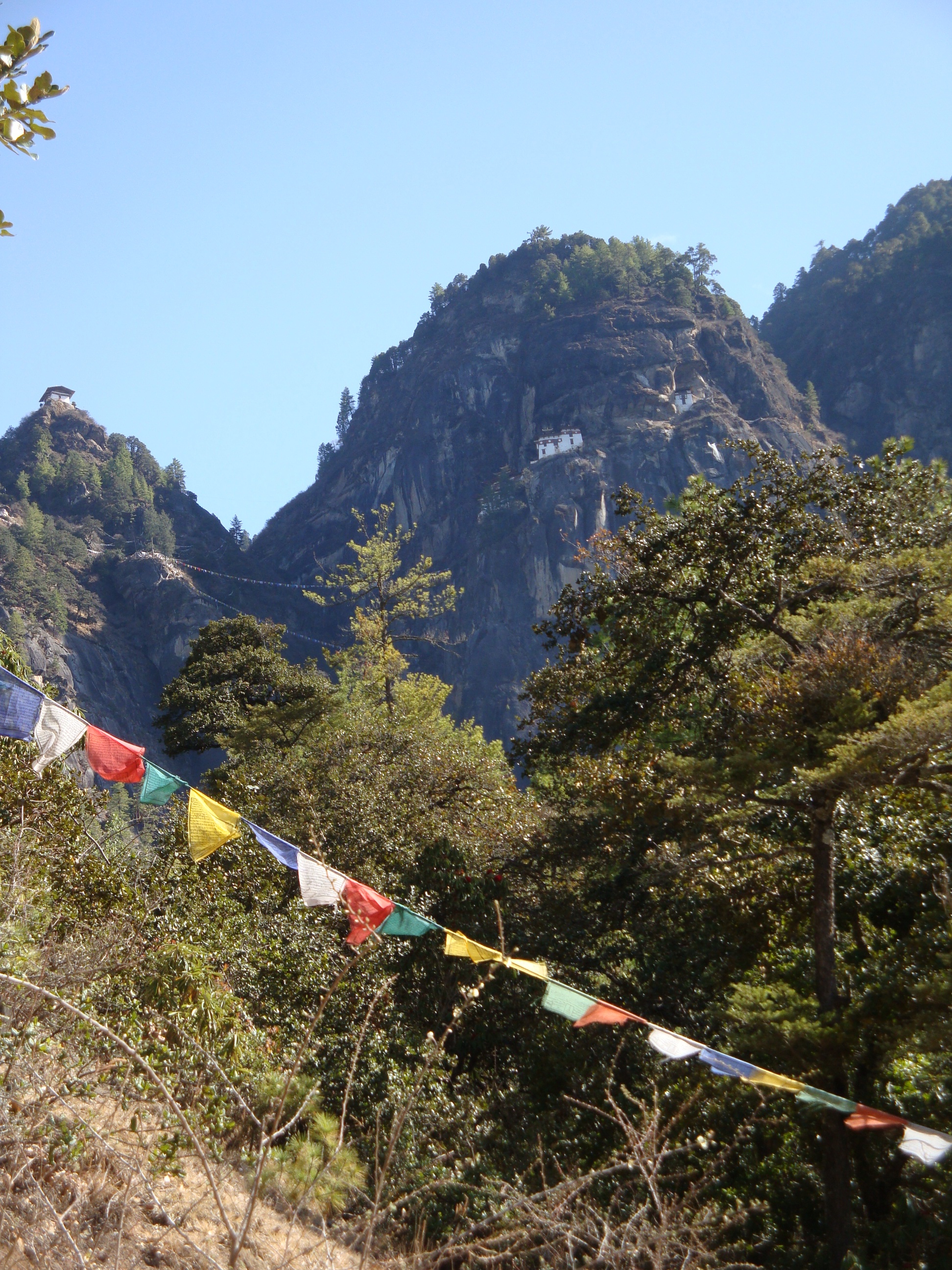
Over on the next mountain and still higher up, we could now see the Monastery in a bit more detail. We climb and climb. Eventually, we are walking through high mountain forest, red rhodos all around, birds singing and the sun filtering through the canopy. Somewhere above us young Monks are practicing the Temple Horns. Either that, or somebody is torturing a Takin.
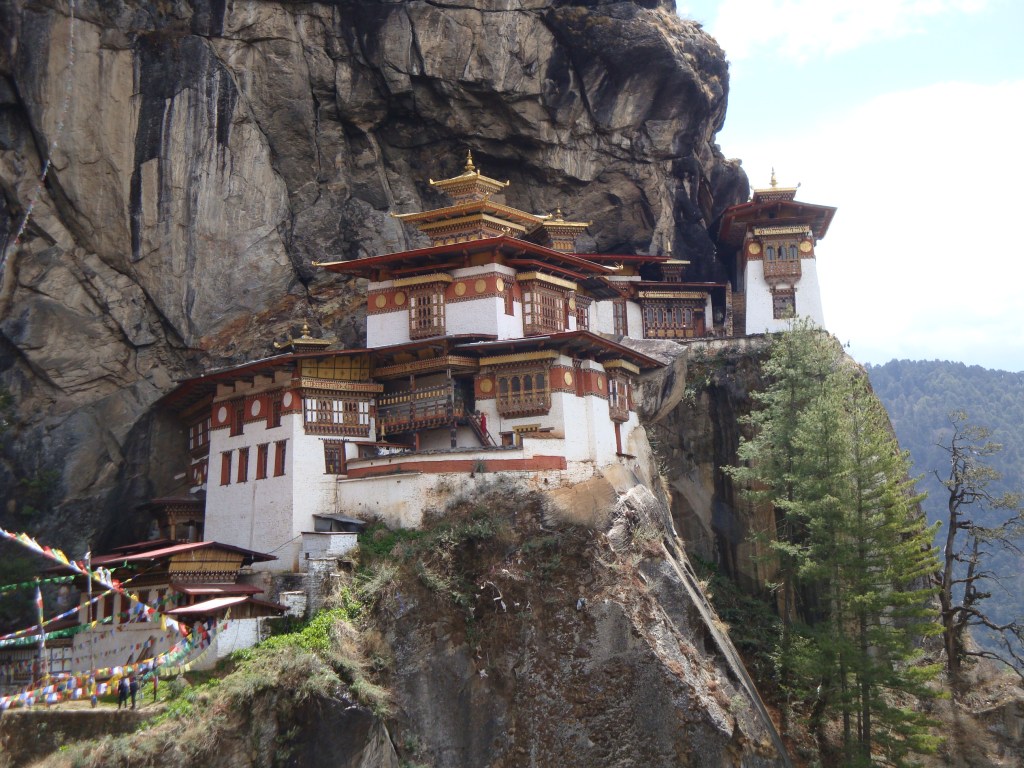
We turn a corner and now we are looking down on the Tiger’s Nest. Stunning. The gorge between us is strung with prayer flags, fluttering in the breeze. The white walls, red and golden roofs. The sheer drop down the cliff face.
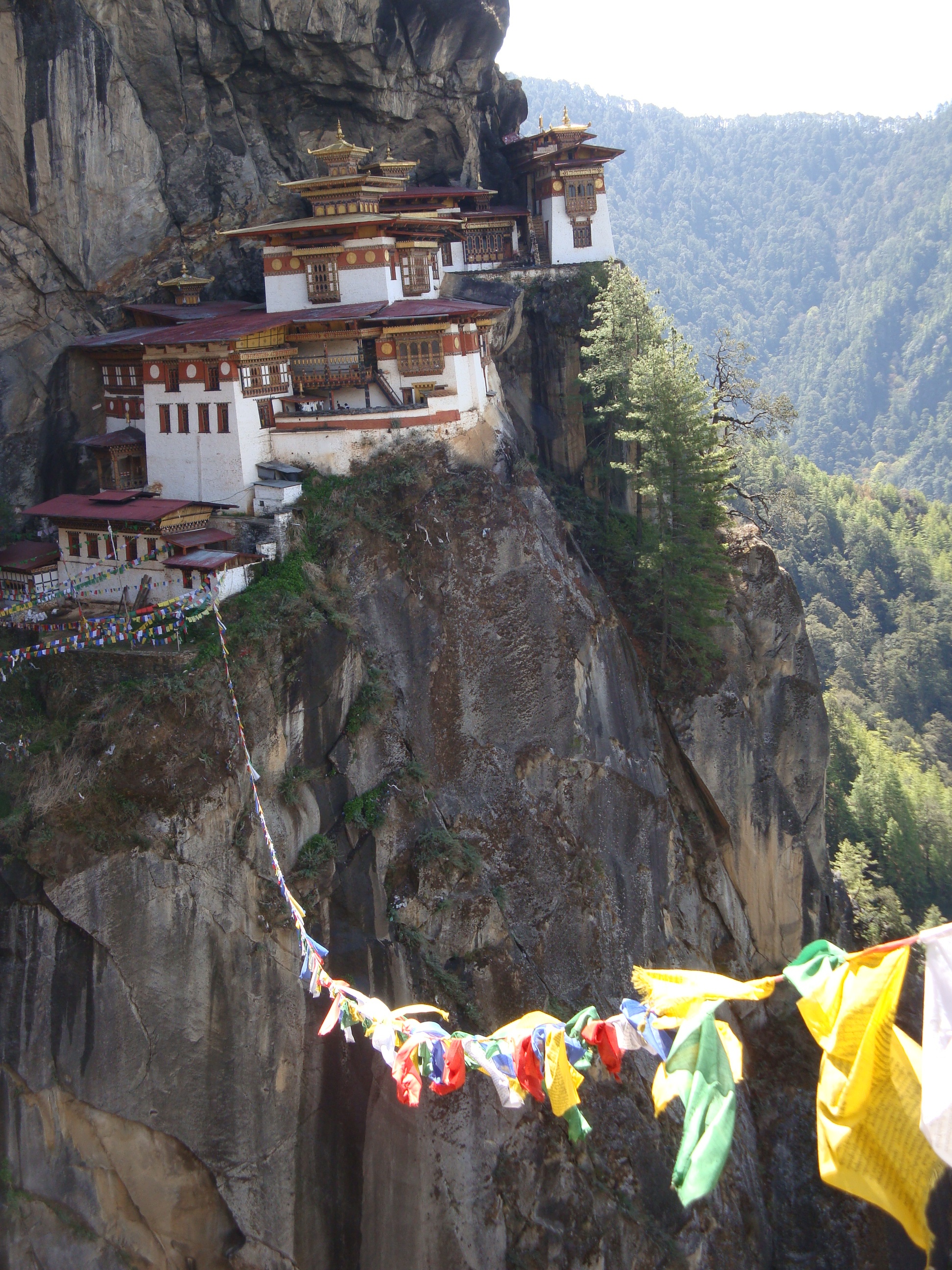
It doesn’t look as if it is clinging to the cliff, more like it has been superglued onto it. How on earth did they build this? And why? According to Tensing, the guys who built this were granted supernatural powers and this is one Religious Belief that I am not going to take issue with. By the looks of it, he might be telling the truth.
We wind down a sheer staircase into a cleft in the mountainside, every twist and turn reveals a different view of the Monastery, my camera is overheating. A high waterfall drops besides us and up above a small fertility temple is squeezed into a fissure, 3 hundred metres of sheer rock above it.
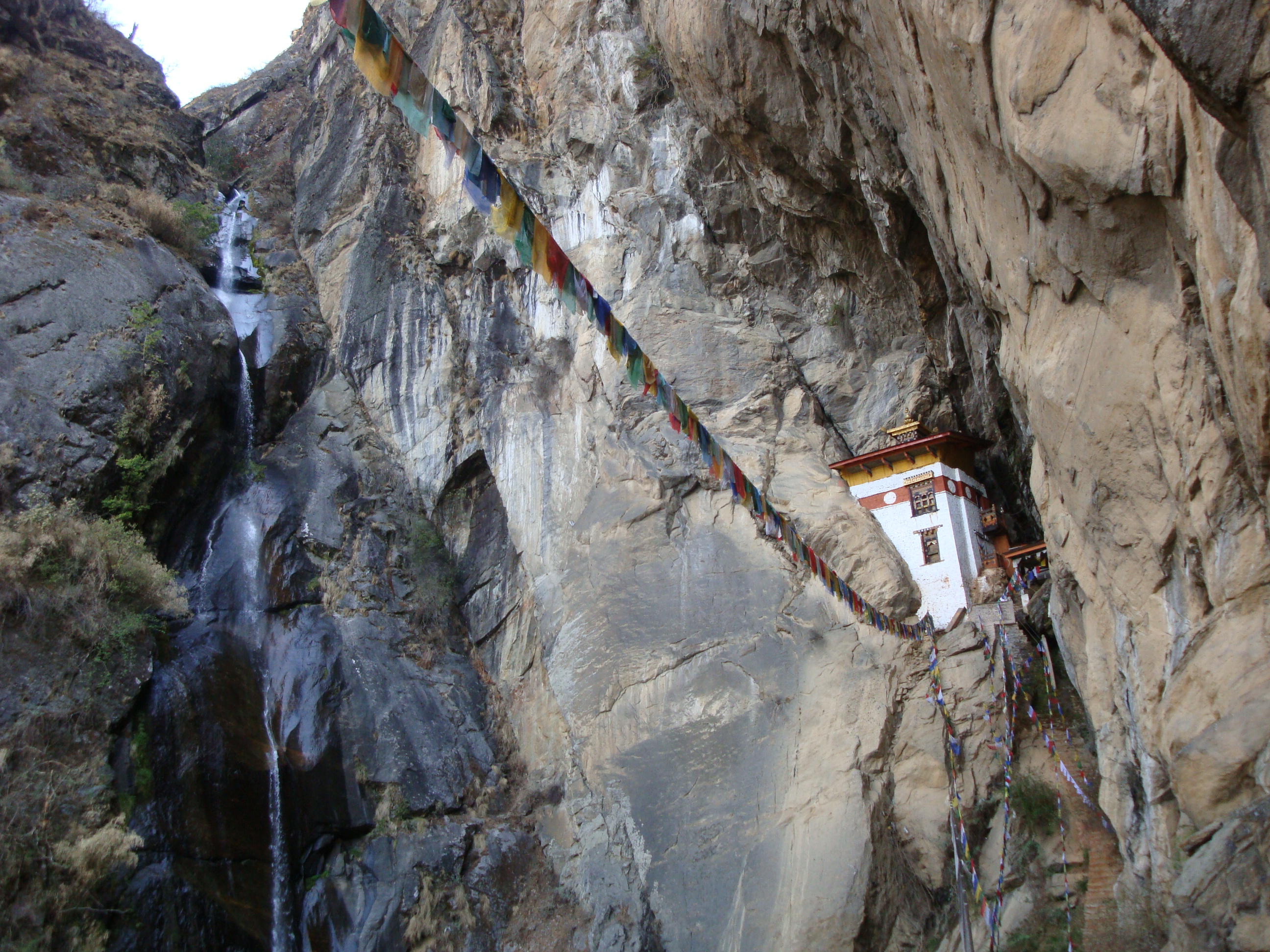
We are told that when the end of the World comes, a door will open in this cliff and all the Monks who ever were will come out. That tea shop back down the way is going to be very busy.
We cross at the head of the gorge and climb into the Monastery, which is cute, but after the outside, it’s going to be difficult to impress us. We play a Bhutanese version of Blind Man’s Buff, which involves shutting your eyes, walking across a patio and putting your thumb in a hole in a rock. What do you win? Merit for your family. I had 3 goes and a very unmeritorious family.
We re-crossed the gorge and climbed back up the winding staircase. At every twist and turn you are convinced that this is the National Geographic photo op. Goodness knows how many we took between us. Some of them are great, but nothing can match the actual experience. We descend the Mountain, stopping only to buy a teapot, teaspoons and a dragon shaped coat hook from an old lady with a serious betel nut habit, half way up a mountain. Goh figure.
200 yards from the van, the skies open and it chucks it down, we must have had more merit than we thought. We stop at a minor Monastery with an orange tree that is always in fruit. Nice, but after Tiger’s Nest everything is going to be a bit of an anti-climax. We check out Paro Dzhong, it’s big and impressive, but we don’t want to get into an argument about whose Dzhong is the biggest. Tensing senses the mood and after all, that’s why this was left until the last day. It’s time for beer and fart fodder and packing and, early the next day, we head back to the airport. We say our farewell to the boys, who are busy fiddling with their backsides but who have been fantastic the whole way and, as the plane climbs out of the valley and through the clouds, we get one last glimpse of Himalayan Heaven.
 Travels, Opinions, Stories and Stuff